How to Become an Effective Sales Coach

Written by: Claire Imber, Director of Content Strategy & Thought Leadership
Published: October 26, 2026
A sales manager's most important job is coaching. An effective coach accelerates learning, changes behavior, and boosts the performance of both individuals and the entire sales team. In a global study of more than 1,000 sales managers and sellers, sellers who reported to top-performing sales managers averaged a 72% win rate, versus an overall average of 47%.
The sales coaching process we use at Richardson Sales Performance is both simple and effective. When managers follow it, the results are clear. The problem is, sales coaching only works if managers do it properly.
Key Takeaways
- Ask first and let the sales professional do most of the talking, because coaching by asking builds commitment, buy-in, and accountability.
- Start each session with a SMART behavioral objective (Specific, Measurable, Achievable, Reasonable, and Time-bound), not a sales target.
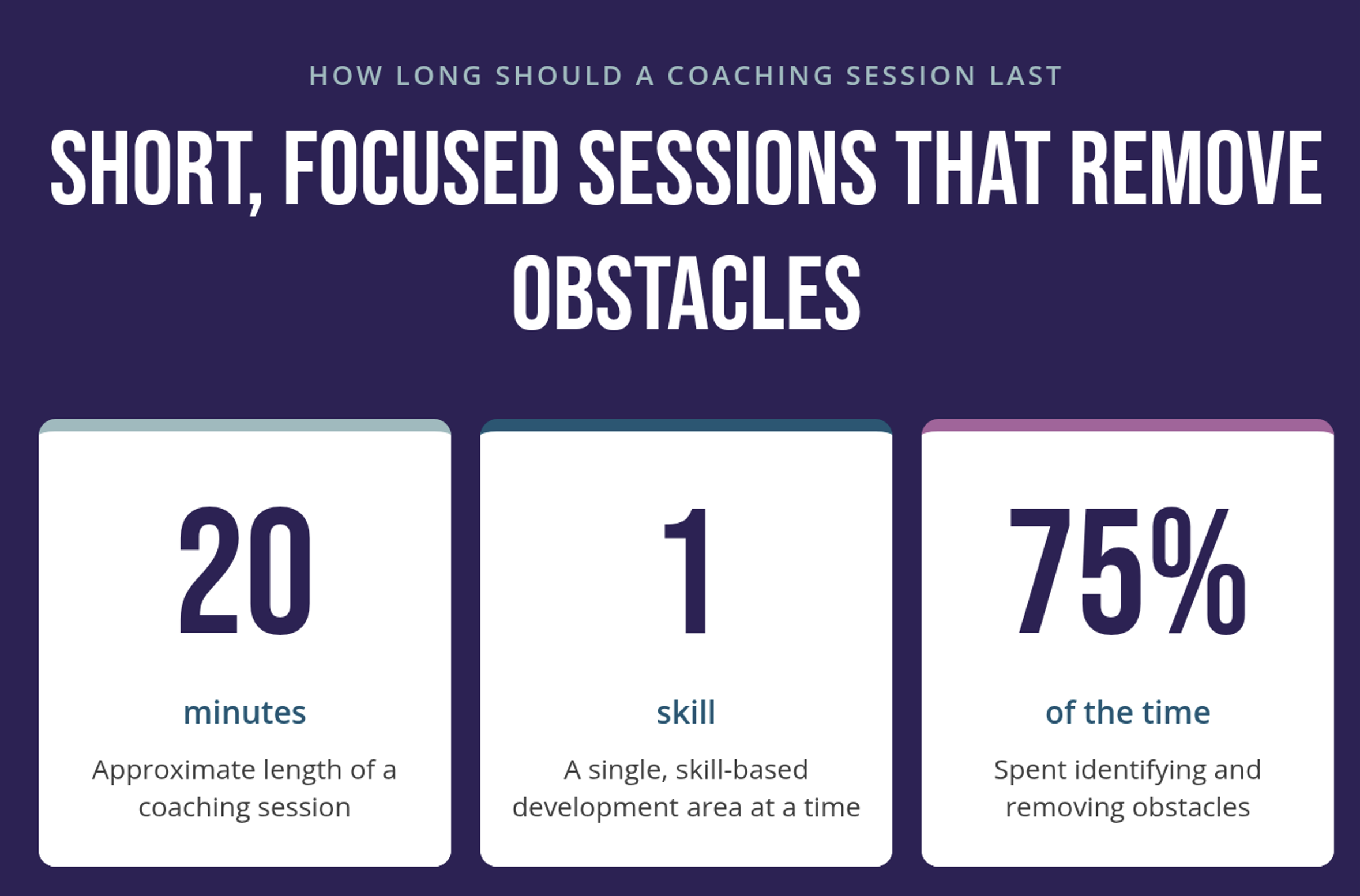
- Keep sessions to approximately 20 minutes on a single skill, spending about 75% of that time identifying and removing obstacles.
- Share the coaching process openly and close with action steps that the sales professional comes up with.
Why does asking work better than telling?
The key to effective sales coaching can be captured in three words: they talk first.
Our coaching model is all about asking specific, neutral, open-ended questions — and then drilling down further with more questions.
Coaching by asking allows coaches to learn about their sales teams and the situations that they face. It builds commitment and buy-in and helps sales professionals take responsibility for their own learning. It also returns time to the coach, because the sales professional takes on more accountability rather than relying on the manager for approval and next steps.
We call it a different kind of FISH: Find Information for Self Help. It enables and empowers the sales professional to find information, identify the source of any obstacle, and come up with solutions, which increases both buy-in and commitment.
How do I keep from taking over the conversation?
Remembering to ask is only the first step. Coaches often find the asking part much easier when initially talking about an issue, but when it comes to finding a solution, the manager hat is quickly donned. They might start with, "What are your thoughts?" or, "How do you feel the call went?" and then slowly start formulating solutions and giving their opinions. In three words: they take over.
Instead, keep the flow of questions going throughout. Get input from the sales professional first, then ask open-ended questions to identify the issues.
When obstacles are uncovered, avoid the temptation to solve the problem. Continue with questions to get the sales professional's perspective. Asking helps them think through the issue.
Some coaches make the mistake of focusing on themselves, acting as subject-matter experts who need to share their expertise with their team. Sales managers typically have valuable experience and business acumen to share, but acting as the expert can get in the way of enabling others to self-develop and grow. It can also be off-putting to constantly hear how things were done in the old days, or, "When I was in your shoes …" That approach focuses attention on the wrong party — the coach instead of the person being coached.
Why is coaching hard for top performers?
Most sales leaders got promoted to their jobs because they were good sellers. And being a good seller isn't the same as being a good sales manager. In fact, sometimes the best sellers don't make good sales managers, and sometimes the best sales managers were not good sellers. The trick is to recognize the difference between being a super seller and being a leader of sellers.
Two ideas help:
- A leader is someone who shows the way.
- A sales leader shows the way and helps their sellers get there on their own.
The problem with this dual role is the tendency for sales leaders — who were super sellers — to take over. They want to step in and solve their reps' problems by doing it for them rather than coaching them in the skills needed to do it on their own.
Coaching works best when sales leaders treat their team as customers: gaining insight into their needs and helping them become better sellers, just as those sellers help their customers.
What makes a good coaching objective?
If you do not know specifically what you want to get out of the coaching session, the conversation will be too long, ineffective, and confusing.
Too often, a coach will say: "My objective is for John to increase sales by 20%." That is certainly a measurable objective, but it is not SMART. Each coaching session should have a desired outcome based on a SMART behavioral objective: Specific, Measurable, Achievable, Reasonable, and Time-bound.
So, if you want John to increase sales by 20%, what behaviors does he need to work on? What is getting in the way of his achieving this goal? Maybe he is not making enough prospecting calls, or he is not talking to the decision maker. Once the team member pinpoints these areas, the conversation focuses on developmental actions. Maybe John works on identifying the decision makers at targeted accounts and schedules phone calls with them over the next three weeks. That is a behavior that the coach can measure and follow up on three weeks later.
What does a coaching conversation look like?
Tell your sales reps that you're using a coaching process, and share what the process is, so that you can use it together. That shows there isn't a hidden agenda.
Coaching is not about you looking like the world's most successful manager and leader. It's about sharing and transferring your knowledge and experience to people who don't have it, collaborating with them in a nonjudgmental way — in a safe space — about what they want to work on.
The process works like a seesaw between you and your sales rep. Each step starts with their view, and then you share yours. Pick one skill area, such as creating customer dialogues and questioning skills, and work through it:
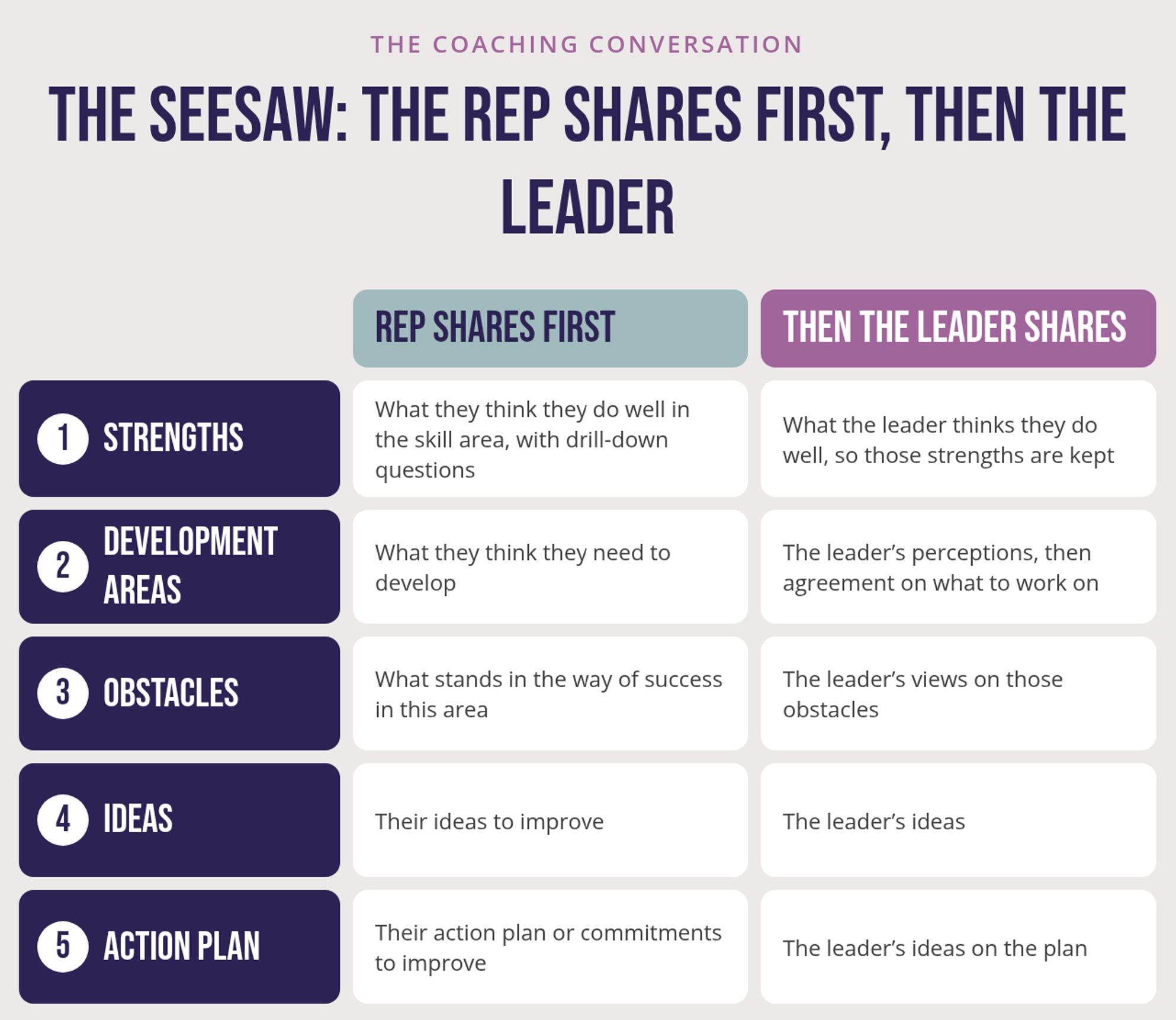
- Strengths. Ask what they think they do well in that area. Listen, and drill down. Then share what you think they do well. It's as important to remember those strengths and keep doing them as it is to improve.
- Development areas. Ask what they think they need to develop. Drill down, then share your perceptions, and agree together on what to work on.
- Obstacles. Ask what stands in the way of success in this area. Share your views.
- Ideas. Ask for their ideas to improve, and share yours.
- Action plan. Ask what their action plan or commitments are to improve. Share your ideas.
We even encourage leaders to take a copy of this framework into the meeting and tell their reps: "We're going to start doing this, and we're all going to work together at getting better because we all need to get better — and that means me, too." The framework makes coaching easy because it lets everyone know what's involved, and it allows everyone to better prepare and perform.
How long should a coaching session last?
Time is a scarce resource for sales managers and coaches. The good news is that developmental sales coaching focuses on frequent, short, impactful sessions to replace and supplement longer ones.
Coaching sessions should last approximately 20 minutes; focus on a single, skill-based development area at a time; and spend about 75% of the time on identifying and removing obstacles.
To close with measurable objectives, Richardson's Developmental Sales Coaching uses a closing framework that includes a summary, action steps, strengthening of the relationship, and a plan to follow up. The agreed-upon action steps follow the acronym STORM: they are specific, time-bound, observable, reasonable, and measurable. Remember: the direct report should be the one to come up with the next steps.
Why do some coaching conversations change nothing?
How many times have you coached someone on the same topic and not seen any credible results? This can occur for several reasons:
- Coaching in an evaluative way. Focusing on numbers, metrics, and how many deals have closed.
- Coaching as an expert. Thinking that you need to have all the answers, and so telling instead of asking what the person should do.
- Coaching without a specific action step. Having a conversation that doesn't leave a tangible output that you can follow up on.
A developmental approach works differently:
It's an effective and incremental process that encourages people to be responsible for their own development.
Think of a sports coach working with an ice skater. The coach helps the skater improve technique and skills in jumps, turns, balance, and form in order to gain a higher score. They don't focus on the numerical values in moving from an 8 to a 10 but instead on the competencies necessary to do so.
If something is holding someone back, assess whether it's an issue of knowledge (what your team needs to know), skills (how they should apply the knowledge), or will (why team members behave as they do).
If you want your sales team to be filled with independent, accountable professionals, coach them to improve their performance. All it takes is the right conversation, asking instead of telling, and coaching on the skills necessary for a long and profitable career.