How to Align Sales Training With the Sales Competencies Your Team Needs
Sales performance improvement

Written by: Erin Smith, Chief Revenue Officer
Published: November 11, 2026
Sales wasn’t always this complicated. It used to be a person-to-person affair, built on handshakes and skilled pitches delivered in person or over copper-wired telephones. Though the foundational sales skills of yesteryear are just as relevant to sales success today as they were in decades past, the context of selling has been transformed by the forces of technology, globalization, and the ubiquitous connectivity of a Wi-Fi-enabled workplace. Sales training and sales effectiveness have been a cornerstone of many organizations’ strategies to increase revenues and drive efficiency. As markets continue to grow and evolve in complexity, learning leaders need to align their organizations’ initiatives with the selling skills needed to succeed in dynamic environments.
It’s not only the skills that sellers need for success that have changed, however. Customers can now educate themselves and access reams of information before ever coming into contact with a seller. Buyers have taken the reins on much of the sales process and move through the cycle on their own terms and at their own pace. Sellers need to adapt to each customer to account for where that customer is along the path to closing a sale, and position products and services accordingly.
So, are companies setting up their sales personnel for success? Are they targeting sales competencies that reflect the 21st-century business landscape? To find out, Training Industry, Inc. and Richardson studied how organizations identify and develop sales competencies. In the fourth quarter of 2016, 228 companies completed a confidential survey reporting their approach to sales competencies, including the relative importance of various competencies, effectiveness at developing those competencies, and the commonly experienced challenges to successful alignment between learning and development and the learning needs of sellers.
Key Takeaways
- Start with the customer. Customer needs are the most influential driver of sales competency strategy.
- Rate each competency on how important it is and how effective your training is, then close the biggest gaps first.
- Prepare sellers to engage customers at every stage of the sales cycle, through a blend of training modalities.
What does it mean to align sales training with sales competencies?
The purpose of identifying a competency is to describe what skills and foundational knowledge are considered necessary for successful performance on the job. An appropriately identified competency, however, encompasses a more contextualized description of such knowledge and skills. A sales competency needs to go well beyond simple notions of “this skill plus that skill plus this knowledge equals good sales.” It represents skills and knowledge as they manifest on the job, subject to the influence of company culture and the business environment.
Planning is a good example. It’s a competency for employees in sales roles, and “planning” represents a distinct set of activities and demonstrated skills such as assessing risks, setting goals, prioritizing those goals, and laying out the steps to achieve them within the framework of a sales cycle.
Merely having a competency is like having a can of paint: It has a lot of potential, but without being used, it doesn’t change a thing about the color of the wall. Sellers must exercise a competency in their jobs for their skills and abilities to affect sales outcomes. Sales training fosters and reinforces desirable clusters of behavior, so aligning training with competencies is what turns that potential into results.
Where should a sales competency strategy start?
With the customer. In the study, customer needs received the highest share of “extremely influential” ratings (35%) of any stakeholder group that shapes a company’s sales competency strategy. Sales leadership was next, at 31%. Very few respondents rated any stakeholder group “not influential,” which suggests that identifying sales competencies means balancing a wide array of needs while distinguishing the themes they share.
Stakeholder needs aren’t the only input. Companies reported drawing on several data sources for strategic planning:
- Feedback from sales managers (58%)
- Feedback from sellers (54%)
- Analysis of financial metrics (49%)
- Feedback from customers (45%)
- Analysis of training metrics (43%)
- Formal needs assessment (43%)
Respondents also rated “understanding customer needs” as the most important competency for sellers to develop, at 83% extremely or very important.
Customer-focused skills remain a challenge. In Richardson and Challenger’s 2026 Selling Challenges research, 33% of respondents named tailoring their biggest pipeline challenge.
Richardson’s competency assessments help with this step. They identify the specific competencies that an individual seller, a team, or an entire sales function should prioritize for development, so the training plan starts from evidence instead of assumption.
How does the changing sales cycle affect the competencies sellers need?
That shift has only accelerated. Gartner’s 2026 sales survey of 646 B2B buyers found that 67% prefer a rep-free buying experience.
Customers have significantly more control over the sales process than they used to, and sellers must be able to engage them at every point in the cycle. In the study, more than 80% of respondents agreed that sellers directly develop relationships at the prospecting stage and interact with customers while identifying their needs. About two-thirds also agreed that sellers engage customers to deliver the pitch and close the sale, and at the follow-up stage.
Together, these results suggest that identifying a customer’s stage in the sales cycle is a critical competency. Sellers also need to apply the right competencies to move the customer along to the next stage. Training that aligns with competencies should address the skills needed to navigate customer engagement at any point in the cycle.
“One of the things that has been most important to me is having a common methodology and even a common vocabulary that we can use to describe where we are in terms of stages in the sales process with all of our team members.” — Kristin Krawczyk, Senior Sales Director, Cencora
How are companies delivering sales training?
Only 26% of respondents rated their company’s sales training “always effective,” so most companies have room to grow. Delivery isn’t the issue. Companies prefer a blend of face-to-face methods, such as on-the-job training and instructor-led classroom training, with technology-enabled modalities, such as video and virtual instructor-led training.
- On-the-job training (66%) and video-based learning (62%) were the two most common modalities.
- 90% of companies use more than one modality to deliver sales training.
- 52% use between three and six different modalities.
To keep training aligned with competencies, match each modality to the ways sellers can most easily consume learning content.
Where are the biggest gaps between competency importance and training effectiveness?
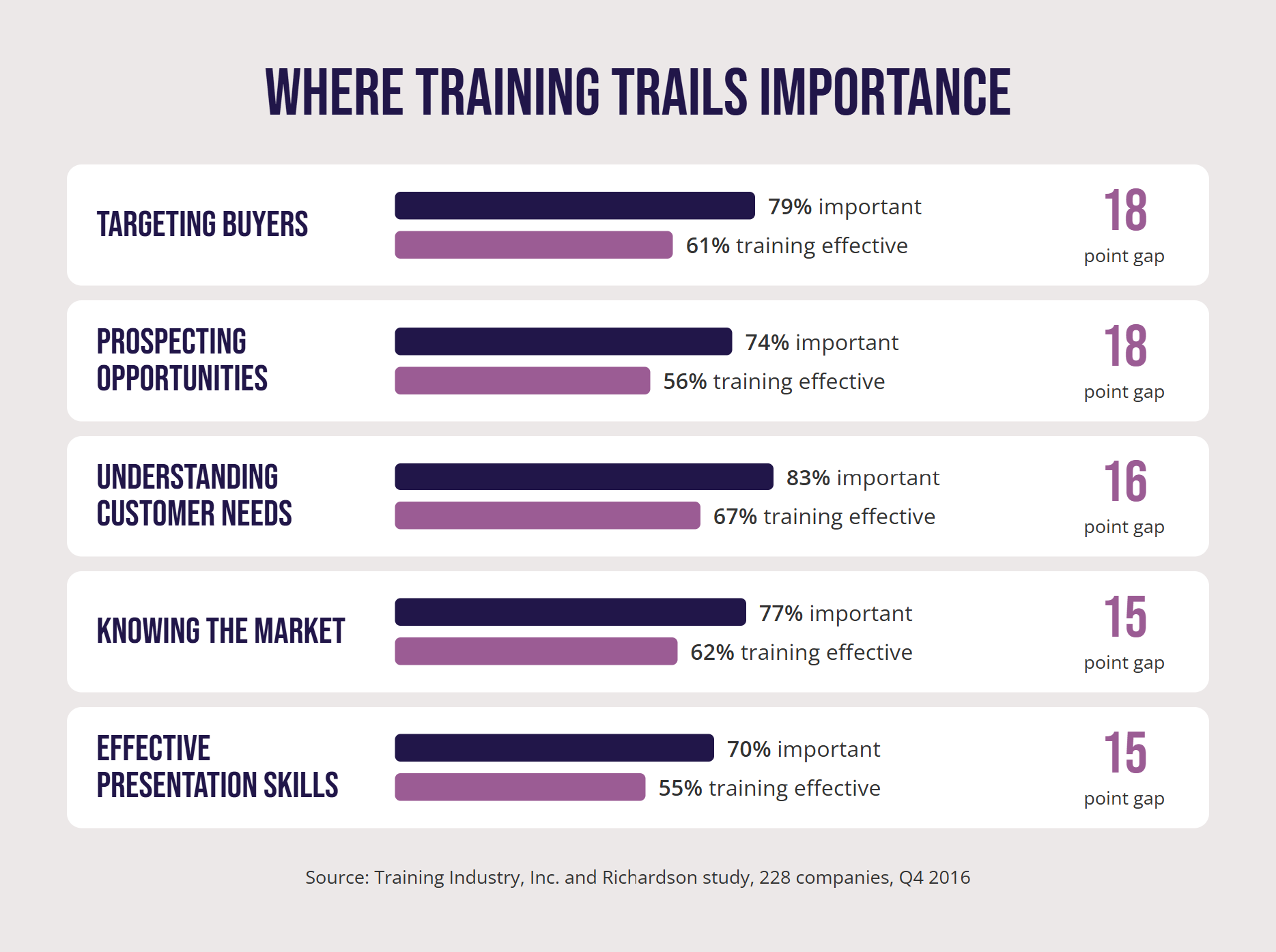
Over half of respondents rated their training as extremely or very effective for every competency studied, which suggests sales training is reinforcing sales competencies at most organizations. In nearly every case, though, training effectiveness trailed strategic importance. The table compares the two, ordered by the size of the gap. The largest gaps were targeting buyers and prospecting opportunities, at 18 points each.
| Competency | Category | Rated extremely or very important | Training rated extremely or very effective | Gap (points) |
|---|---|---|---|---|
| Targeting buyers | Selling skills | 79% | 61% | 18 |
| Prospecting opportunities | Selling skills | 74% | 56% | 18 |
| Understanding customer needs | Customer relations | 83% | 67% | 16 |
| Knowing the market | Market knowledge | 77% | 62% | 15 |
| Effective presentation skills | Customer relations | 70% | 55% | 15 |
| Expanding current accounts | Customer relations | 68% | 54% | 14 |
| Negotiation and closing | Selling skills | 70% | 57% | 13 |
| Planning and strategizing | Selling skills | 71% | 59% | 12 |
| Resolving objections | Selling skills | 68% | 56% | 12 |
| Positioning the company in the market | Market knowledge | 67% | 55% | 12 |
| Leveraging market insights | Market knowledge | 64% | 52% | 12 |
| Identifying customers’ initial stage in the sales cycle | Customer relations | 72% | 60% | 12 |
| Establishing customer relationships | Customer relations | 79% | 68% | 11 |
| Positioning products and services | Market knowledge | 74% | 64% | 10 |
| Becoming a trusted advisor | Customer relations | 71% | 62% | 9 |
| Selling with teams | Selling skills | 58% | 55% | 3 |
Understanding customer needs stands out. Respondents rated it the most important competency, and training for it earned one of the highest effectiveness ratings, but a 16-point gap remains. That mismatch makes customer needs one of the highest priorities for any learning function serving sales employees.
What gets in the way of aligning training with competencies?
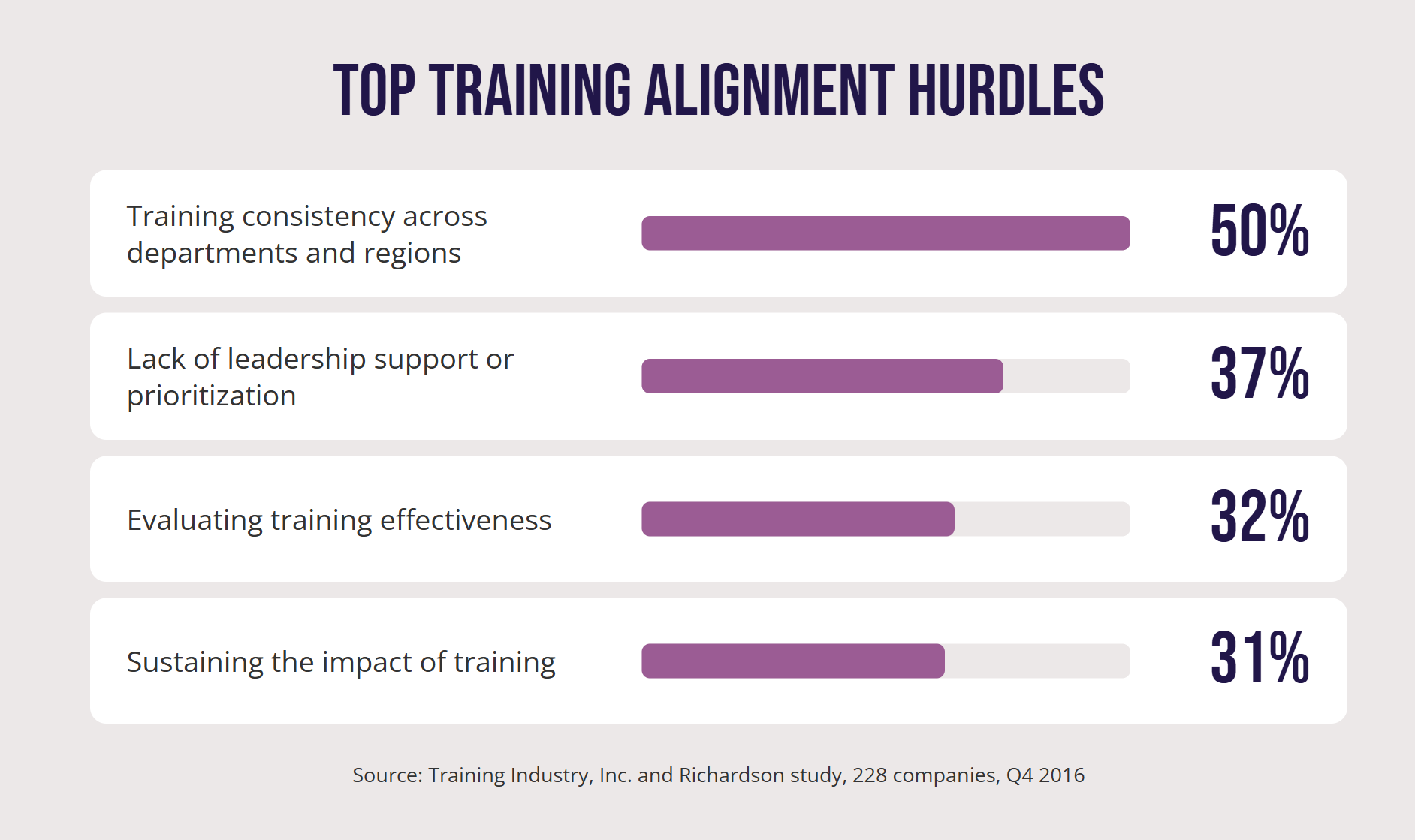
About three-quarters of companies didn’t rate their sales training “always effective.” Half of respondents named training consistency across departments and regions as the single most frequent hurdle. Lack of leadership support or prioritization of training (37%), evaluating training effectiveness (32%), and sustaining the impact of training (31%) followed.
“With Richardson, what I love about it is we were able to scale the entire framework throughout our organization globally. So you’re getting that same language, that same framework with consistency, which keeps that brand.” — Darnetta Daire, Sales Enablement Manager, Hollister Incorporated
Respondents also agreed on a set of obstacles to effectiveness:
- Allowing too much complacency in training implementation (68%)
- Issues identifying employees who need training (62%)
- Failing to address obstacles related to organizational culture and structure (61%)
- Failing to reinforce newly trained skills in salespeople (61%)
- Sellers who aren’t motivated or incentivized to engage with training (61%)
Where should learning leaders start?
The study points to five steps:
- Offer training across a range of modalities. Match the modalities to the ways sellers can most easily consume learning content.
- Put customer needs first. Treat them as the main driver of competency strategy, and draw on feedback from sales managers and sellers as well.
- Align competencies to every stage of the sales cycle. Sellers interact with customers from prospecting through follow-up.
- Close the gaps between importance and effectiveness. Start with targeting buyers, prospecting opportunities, knowing the market, understanding customer needs, presentation skills, and expanding current accounts.
- Make consistency a priority. Plan for consistent delivery across functions and geographies, and for the follow-through that sustains it.
Richardson’s Accelerate Prism is an AI-orchestrated platform that connects learning, coaching, reinforcement, and performance visibility, which helps managers see where sellers are succeeding and where coaching is needed. Those are the same gaps respondents named: reinforcement and manager support.
About the research
Training Industry, Inc. and Richardson surveyed 228 companies in the fourth quarter of 2016. Respondents represented organizations ranging from fewer than 100 to more than 50,000 employees. Durable goods and consumables made up the largest industry group (36%), and 44% of respondents were managers.