Sales Negotiation Myths: Three Outdated Ideas and What Sellers Should Do Instead
Sales performance improvement

Written by: Ben Taylor, MBA, Content Marketing Manager, Richardson
Published: November 24, 2026
Many of the most popular ideas about negotiating have outlived their usefulness. While helpful at one time, these outdated ideas no longer hold up in a setting that has become more complex.
When these myths work against the seller, they do so in unseen ways. A seller might consider the signed contract a win when, in fact, they have left money on the table. The seller might assume that a customer's demand can only be met by reducing the scope of the sale. It might seem as though silence is a sign that the deal is deteriorating when, in fact, remaining calm is a way to reaffirm one's position.
Key Takeaways
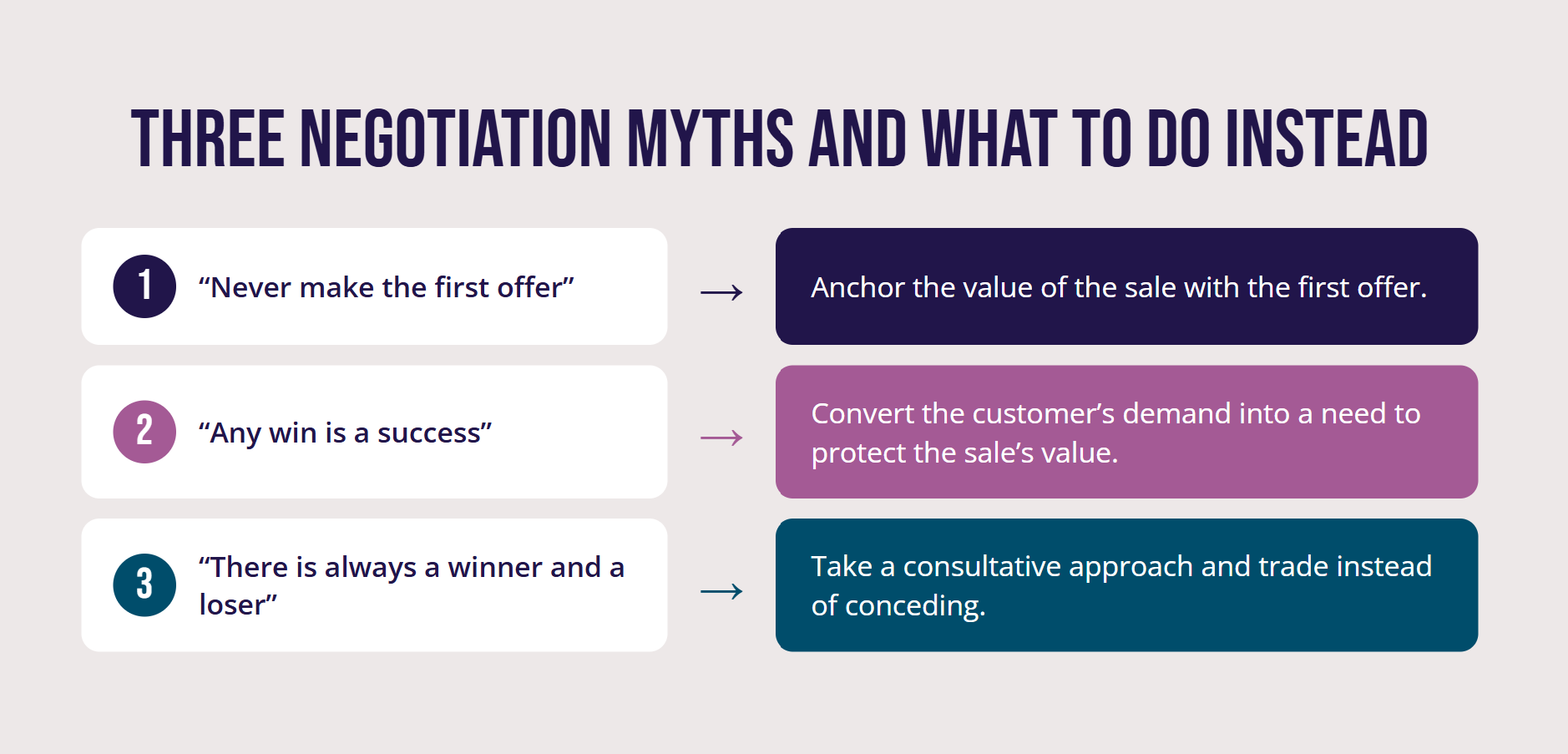
- The three most persistent negotiating myths are "never make the first offer," "any win is a success," and "in any negotiation, there is a winner and a loser."
- Research points the other way on each one.
- Sellers should anchor value with the first offer, convert customer demands into needs, and trade instead of conceding.
Why do outdated negotiating myths persist?
Today, there are more people involved in business negotiations. Buyers have more options, giving them more leverage. Information flows freely, which shapes the buyer's perceptions of value.
These factors have made negotiating far more difficult for sellers. Adding to this difficulty is the fact that negotiation mainly occurs at the end of the sales pursuit, when the seller is hyper-focused on closing the deal. In this state, it's easy to resort to "rule of thumb" negotiation strategies that have little value or can even work against the seller.
If sellers can recognise and overcome the most enduring myths about negotiating, they immediately make themselves more effective while keeping the door open for future deals.
Myth 1: You should never make the first offer
Many think that making the first offer risks presenting a number lower than what the other side is willing to accept. Research points the other way. The advantage tends to lie with the person who makes the first offer. This approach is called anchoring.
Anchoring is the act of setting expectations. When a seller makes the first offer, they "anchor" the solution's value to a particular number. As a result, the customer's response is not likely to deviate very far from the initial number.
What does the research on anchoring show?
Some of the early research on this concept comes from Nobel laureate Daniel Kahneman and mathematical psychologist Amos Tversky. In a 1974 experiment, they asked a group of students to estimate, in five seconds, the product of 8 × 7 × 6 × 5 × 4 × 3 × 2 × 1. They asked another group to estimate 1 × 2 × 3 × 4 × 5 × 6 × 7 × 8. The correct answer is 40,320. The median estimate for the first equation was 2,250. The median estimate for the second was only 512. Seeing bigger numbers earlier had an enormous impact on perceptions of value.
The effect is strong enough to measure. A 2006 meta-analysis by Chris Guthrie and Dan Orr of Vanderbilt University Law School found a correlation of 0.497 between the opening anchor and the outcome of the negotiation. In lay terms, the authors explain, every dollar added to an opening offer is associated with roughly 50 cents more in the final sale price.
Does anchoring work on experienced negotiators?
What if the customer is an experienced negotiator? The same research found that the correlation is still 0.37. Experience softens the anchoring effect, and knowing about it doesn't remove it. That's the power of anchoring.
Does the first offer always win?
A 2025 meta-analysis of 90 studies found that first movers come out ahead in roughly 60% of negotiations. The same research found that the anchoring effect weakens as a negotiation involves more issues, and that very ambitious first offers raise the risk of ending with no deal. That's why sellers anchor with a number they can support, then use trading to protect it.
Myth 2: Any win is a success
To win the sale, an eager seller is inclined to accept a customer's demand, even if it is a major one. This tendency comes from the need to reach a win rate or hit a quarterly quota, even if doing so means giving in to cost demands. In truth, it's possible to address a customer's demand in a way that satisfies the customer's requirement while preserving the sale's financial value. To do so, the seller must convert the customer's demand to a need.
What's the difference between a demand and a need?
There is an important distinction to be made between demands and needs. A demand is nonnegotiable. It is an ultimatum. A need, however, is a requirement that can be met in various ways. The seller who can convert a demand to a need will succeed because they can meet that need in ways that do not require sacrificing valuable factors like payment terms, pricing, or the scope of the sale.
How do you convert a demand to a need?
Converting a demand to a need requires three specific skills:
- Acknowledge the demand neutrally. The key is letting the customer know their position has been received. Acknowledging the customer's position, and the feeling behind it, is what Chris Voss, the former lead international kidnapping negotiator for the FBI, calls labelling. Neutrally acknowledging someone is an act of empathy. It breaks down the wall between the seller and the customer.
- Uncover the underlying need. The seller needs to know where the demand came from. Knowing the answer helps reveal how the seller can address the need in a variety of ways rather than just agreeing to the surface-level demand.
- Shape perceptions of value. The seller focuses the customer on what they will gain by reaching an agreement and what they will lose by falling short. Creating this influence is important because it makes the customer more receptive to a trade later.
Myth 3: There is always a winner and a loser in a negotiation
A negotiation is not a zero-sum game. It is possible to reach a mutually beneficial outcome. Doing so opens the door for future opportunities to expand or extend the partnership. Unfortunately, too many people believe that one side's success must come at the cost of the other.
A 2002 study published in the Harvard Negotiation Law Review asked lawyers to evaluate the negotiation styles of other lawyers. It found that negotiators who are assertive and empathetic are perceived as more effective, and that problem-solving behaviour is perceived as highly effective.
What does a consultative approach look like in a negotiation?
Developing this style means taking a consultative approach in which the seller builds trust, reinforces the relationship, and meets the customer's needs. Being consultative is a balancing act. The seller must not slip from consultative to accommodating or from consultative to competitive. Maintaining a consultative approach takes preparation, focus, skill, and careful phrasing. One way to remain consultative without conceding is to have a trading strategy.
Customers notice the difference. Jeanne Delancey, director of commercial learning and development at Cencora, describes Richardson as "a great consultative partner" and says, "you guys walk the walk and talk the talk."
What's the difference between a concession and a trade?
A concession happens when a seller gives something up and gets nothing back. Narrowing the scope of a solution to fit a customer's budget is one example. Concessions are one of the most common traps in a negotiation, and trading guards against them.
When a seller trades, they give something and get something in return. Put simply, trading is not unilateral — it is cooperative. Richardson's Consultative Negotiations framework builds trading into a six-step approach: Prepare – Open – Control – Trade – Close – Act.
How do you build a trading strategy?
To implement a trading strategy, the seller must know three things:
- What to trade. They need to know the intrinsic and extrinsic value of every aspect of the deal.
- When to trade. They should space trades in increments to make their value more perceptible.
- How to trade with clarity. They should explicitly communicate what they are trading with specific, intentional language.
What does a successful negotiator do differently?
Being a successful negotiator means moving past the enduring myths that undercut effectiveness.
Sellers should anchor the value of the sale by making the first offer. They should also have a clear plan for converting the customer's demands to needs to protect the financial value of the sale. Finally, effective negotiators must remember that mutually beneficial outcomes are not only possible but necessary for continuing the business relationship.
Richardson clients typically see a 20% improvement in close rate, a 1.5% uplift in margin, and a 25% increase in sales productivity.