Why Sales Insights Don’t Improve Execution Without Skilled Facilitation
Sales enablement

Written by: agrodnitzky
Published: April 28, 2026
Why Don’t Sales Insights Always Improve Sales Execution?
Sales insights do not always improve sales execution because visibility alone does not change seller behaviour. AI tools, conversation intelligence, pipeline analytics, and coaching platforms can reveal where deals stall and where sellers struggle, but sellers still need structured practice, precise feedback, and skilled facilitation to apply new behaviours in live customer conversations.
For sales leaders, the challenge is no longer simply identifying performance gaps. The challenge is helping sellers close those gaps with confidence, consistency, and judgment. This article explains why insight alone falls short, how skilled facilitation bridges the gap between knowing and doing, and what to look for in a sales training partner that can drive real behaviour change.
Keep reading to learn how to turn sales performance insights into stronger execution, more confident sellers, and more consistent customer conversations.
Complete the form below to download the brief, "The Missing Link Between Insight and Execution," to learn what separates skilled facilitators from typical trainers and how they build real selling confidence to increase performance.
The Sales Execution Gap: When Visibility Outpaces Behaviour Change
There is no shortage of visibility in today’s sales environment. Sales organisations have access to more data than ever before. Technology can analyse conversations, identify missed opportunities, highlight stalled deals, recommend next steps, and show how top performers behave. But greater visibility has not automatically produced better sales execution.
In fact, Richardson’s Selling Challenges research found that only 29% of respondents hit or exceeded quota last year. That means many sales organisations have more insight into performance than ever, yet still struggle to create consistent execution across their teams.
This is the sales execution gap: the distance between knowing what needs to improve and helping sellers perform differently in the moments that matter.
Sales technology can show leaders:
- Where deals are slowing down
- Which opportunities are at risk
- What sellers are doing differently
- Which behaviours correlate with stronger outcomes
- Where coaching might be needed
But sales technology cannot, on its own, build the judgment, confidence, and adaptability sellers need in live customer conversations. That is where the missing link appears.

Why AI Can Diagnose Sales Performance Gaps but Cannot Close Them Alone
AI can identify sales performance gaps by analysing conversations, surfacing missed opportunities, and recommending next steps. However, AI cannot fully close those gaps because sales execution requires judgment, timing, confidence, and adaptability in live customer conversations.
These are human capabilities. They develop through practice, coaching, repetition, feedback, and reinforcement.
AI can help sales leaders understand where sellers are struggling. It can reveal that sellers are not asking enough purpose-driven questions, failing to build urgency, or struggling to respond to stakeholder resistance. But identifying those issues is not the same as changing the seller behaviours that cause them.
A seller might know they need to ask better questions. They might understand the framework. They might even receive a coaching prompt before a call. But when they are in a high-stakes conversation with a senior decision-maker, they still need to know how to listen, respond, adapt, challenge, and advance the conversation in real time.
That kind of execution is built through experience. And in a sales training environment, that experience depends on skilled facilitation.

The Seller Skill Gaps That Keep Deals from Moving Forward
The most persistent sales challenges often happen inside live customer conversations. They are difficult to solve because they require sellers to combine several skills at once, including preparation, questioning, listening, business acumen, value articulation, negotiation, and stakeholder management.
Richardson’s Selling Challenges research highlights several examples of these seller skill gaps:
| Seller Challenge | Percentage of Respondents |
| Sellers struggle to consistently ask purpose-driven questions | 33% |
| Sellers struggle to help customers see the cost of the status quo | 30% |
| Sellers struggle to address stakeholder resistance | 28% |
These challenges are not simply knowledge gaps. Most sellers understand that they should ask better questions, create urgency, and address resistance. The difficulty is doing those things effectively when the conversation is complex, emotional, or high pressure.
That is why more information alone does not solve the problem.
Sales leaders can give sellers playbooks, call recordings, AI-generated insights, and coaching notes. But sellers still need opportunities to practice new behaviours, receive feedback, and refine their approach until they can perform with confidence.
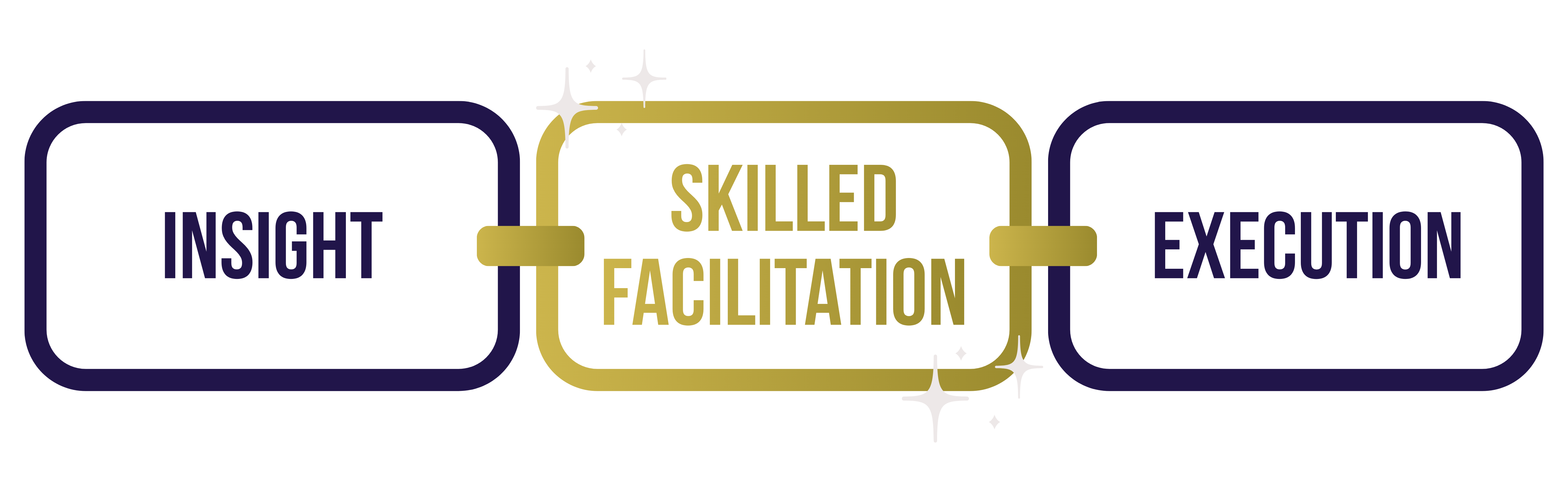
How Skilled Facilitation Bridges the Gap Between Insight and Execution
The gap between sales insight and sales execution closes when sellers move from awareness to behaviour change.
Skilled facilitation helps make that shift possible.
A strong facilitator does more than deliver training content. They create an environment where sellers can apply new concepts, practice realistic scenarios, receive precise feedback, and build confidence through repetition.
Effective facilitation helps sellers:
- Practice realistic, high-stakes customer scenarios
- Receive targeted coaching in the moment
- Work through situations that reflect their actual sales environment
- Adjust their approach under pressure
- Build confidence through repetition and refinement
- Turn sales concepts into observable selling behaviours
This is where behaviour change begins.
Sellers need to see what good looks like, try it themselves, receive feedback, and try again. They need to experience the difference between understanding a concept and using it effectively in a live conversation.
Skilled facilitators guide that process. They help sellers build the confidence and capability to execute when it matters most.
Facilitation Is More Than Teaching
Not all facilitation drives behaviour change. In many sales training programmes, facilitators deliver content instead of adapting to the room. Practice is scripted and time-bound. Feedback is broad or generic. Sessions prioritise completion over skill mastery.
The result is a training experience that helps sellers understand concepts but does not always help them change behaviour. Effective facilitation is different.
Facilitation is not just teaching. It is the live, adaptive process of helping sellers apply new skills in realistic situations, receive targeted feedback, and refine their approach until behaviour improves.
Strong facilitators know when to pause, probe, challenge, redirect, and coach. They can read the room, adapt to participant needs, and connect learning concepts to real customer situations. They help sellers practice not just until they complete the exercise, but until they improve.
This matters because sales execution is contextual. Sellers need to know how to adjust their approach based on the customer, the buying committee, the opportunity, the level of urgency, and the resistance they encounter.
A facilitator who simply presents content cannot build that capability. A skilled facilitator can.
What Skilled Sales Training Facilitation Looks Like
Skilled sales training facilitation creates an active learning environment where sellers are expected to participate, practice, reflect, and improve.
In these environments, sellers do not passively consume information. They work through realistic selling situations. They apply frameworks. They practice conversations. They receive feedback. They refine their language, approach, and decision-making.
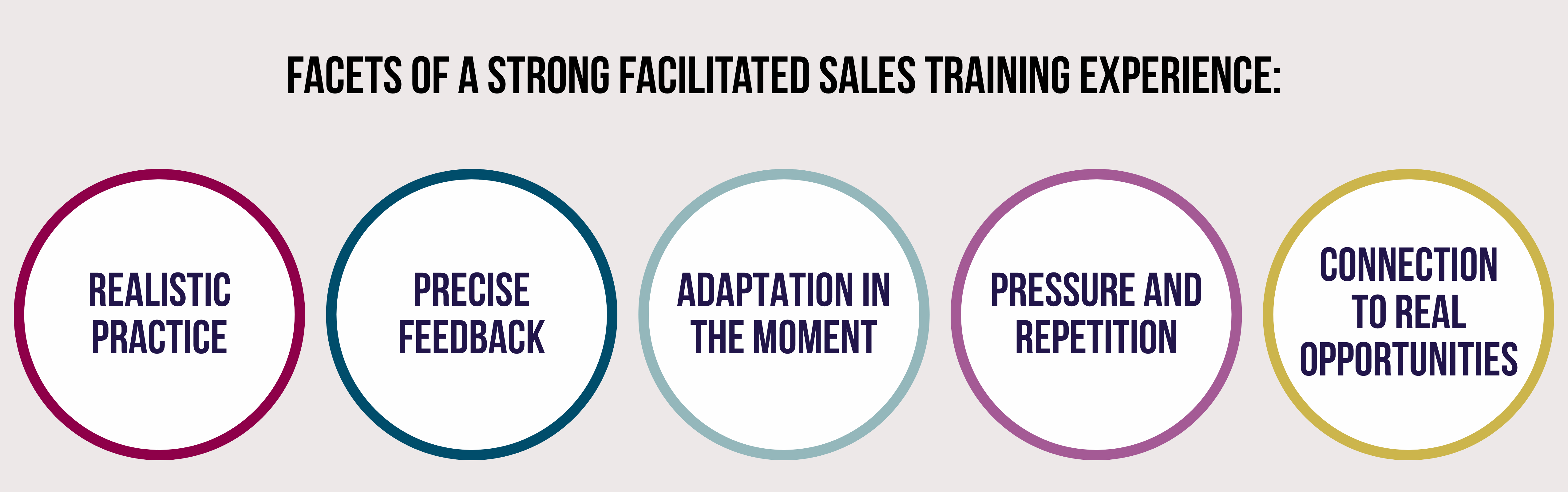
A strong facilitated sales training experience should include:
1. Realistic Practice
Sellers need scenarios that reflect the complexity of their actual sales environment. Generic role plays are less effective when they do not mirror the objections, stakeholders, pressures, and business challenges sellers face every day.
2. Precise Feedback
Broad feedback does not drive meaningful improvement. Sellers need specific, behaviour-based feedback that helps them understand what worked, what did not, and what to do differently next time.
3. Adaptation in the Moment
A skilled facilitator adjusts the session based on participant responses. If sellers are struggling with a concept, the facilitator can slow down, reframe the idea, provide examples, and create additional practice opportunities.
4. Pressure and Repetition
Sellers build confidence by practicing under realistic pressure. Repetition helps them internalise new behaviours so they can use them naturally in customer conversations.
5. Connection to Real Opportunities
Training becomes more valuable when sellers can connect new skills to active opportunities, current accounts, and real buyer conversations.
How Facilitation Supports Sales Behaviour Change
Sales behaviour change happens when sellers repeatedly practice the right behaviours in the right context and receive coaching that helps them improve.
This is why facilitation is such an important part of sales training. It helps sellers move through the full learning process:
- Understand the concept
- See the behaviour modeled
- Practice the behaviour
- Receive feedback
- Refine the approach
- Apply the behaviour in real customer conversations
- Reinforce the behaviour over time
This process complements digital learning, AI-driven coaching tools, and self-paced modules. Digital learning can introduce concepts and reinforce knowledge. AI can surface insights and provide guidance in the flow of work. But facilitated learning gives sellers the live practice and feedback needed to build real capability.
The best sales training experiences combine these elements into a continuous cycle of learning, application, coaching, and reinforcement.
What to Look for in a Sales Training Facilitation Partner
Choosing the right sales training partner is not only about curriculum. It is also about the quality of facilitation.
A strong facilitation partner should be able to deliver more than polished content. They should help sellers build skills, confidence, and behaviour change in the context of real selling challenges.
When evaluating a sales training facilitation partner, look for:
- A global, tenured facilitator bench
- Deep experience in sales, marketing, and go-to-market roles
- A practical understanding of seller and manager challenges
- Experience driving behaviour change as both a leader and facilitator
- Knowledge of adult learning and behavioural theory
- Programmes designed around how professionals build and retain skills
- Content that reflects today’s selling environment
- The ability to adapt sessions based on participant responses
- Practice scenarios grounded in real customer situations
- A focus on skill mastery, not just course completion
The best facilitators create the kind of human learning experience that technology alone cannot replicate. They challenge sellers to go deeper, think differently, and improve in the moment.
From Sales Assessment to Sales Behaviour Change
Many sales organisations have invested heavily in assessment, analytics, and insight. These investments are valuable. They help leaders understand what is happening across the sales organisation.
But insight is only the starting point.
Sales organisations that prioritise insight often:
- Equip sellers with more information
- Increase visibility into performance
- Expand access to coaching signals
- Identify patterns in seller behaviour
- Diagnose risks in the pipeline
Sales organisations that prioritise behaviour change go further. They use those insights to strengthen execution.
They:
- Use live facilitation as a bridge between skill development and execution
- Help sellers practice critical behaviours in realistic scenarios
- Strengthen execution in customer conversations
- Accelerate adoption of new sales behaviours
- Improve consistency across teams
- Increase reliability in pipeline progression
Revenue outcomes follow execution quality. And execution quality follows behaviour change.
That means sales leaders need to ask a critical question: Are we only showing sellers what needs to improve, or are we helping them build the capability to improve it?
How Richardson Helps Sellers Close the Confidence Chasm
Sales organisations are under pressure to improve performance, strengthen pipeline quality, and create more consistent execution across teams. AI and analytics can help leaders see where performance breaks down, but sellers still need the confidence and capability to act differently in live customer conversations.
Richardson helps sales organisations close that confidence chasm.
Through expert-led facilitation, realistic practice, coaching, reinforcement, and learning experiences customised to the team’s selling environment, Richardson helps sellers turn insight into action. The goal is not simply to help sellers understand what good looks like. The goal is to help them execute with confidence when it matters most.
Skilled facilitation is the missing link between sales insight and sales execution. It helps sellers move from knowing what to do to doing it consistently, effectively, and confidently in front of customers.
FAQ: Sales Insight, Sales Execution, and Skilled Facilitation
Q: What is the difference between sales insight and sales execution?
A: Sales insight is information that reveals what is happening in the sales process, such as where deals stall, which behaviours top performers use, or where sellers miss opportunities. Sales execution is the seller’s ability to apply the right skills, judgment, and behaviours in live customer conversations.
Q: Why doesn’t more sales data automatically improve performance?
A: More sales data does not automatically improve performance because data identifies problems but does not change behaviour. Sellers need practice, coaching, feedback, and reinforcement to translate insights into better execution.
Q: How does facilitation improve sales training outcomes?
A: Facilitation improves sales training outcomes by helping sellers practice realistic scenarios, receive targeted feedback, refine their approach, and build confidence applying new behaviours in customer conversations.
Q: What makes a good sales training facilitator?
A: A good sales training facilitator adapts to the room, uses real customer context, challenges sellers to think differently, provides precise feedback, and guides practice until sellers can demonstrate improved behaviour.
Q: How can sales leaders close the gap between insight and execution?
A: Sales leaders can close the gap by pairing performance insights with structured learning, expert facilitation, realistic practice, manager coaching, and reinforcement that helps sellers apply new behaviours consistently.
Q: Can AI replace sales training facilitation?
A: AI can support sales training by identifying skill gaps, surfacing coaching opportunities, and reinforcing learning in the flow of work. However, AI cannot fully replace skilled facilitation because sellers still need human feedback, contextual practice, and judgment-building experiences.
Q: Why is behaviour change important in sales training?
A: Behaviour change is important because sales performance improves when sellers consistently apply new skills in real customer conversations. Training that only builds knowledge may improve understanding, but training that changes behaviour improves execution.