The Psychology Behind Customer Decisions: What Sellers Need to Know
Sales performance improvement

Written by: Ben Taylor, MBA, Content Marketing Manager, Richardson
Published: November 24, 2026
Why is something as simple as a cup of coffee enough to change someone's international travel plans? Why are bronze medallists happier than silver medallists? Why does crossing a dangerous suspension bridge influence a choice made afterward?
The answers lie in the social science of how people decide. On the surface, people appear to follow rational and logical processes when making choices. Below the surface, however, are factors pushing us toward, or away from, a decision. Richardson's review of research from Nobel laureates, leading psychologists, and behavioural economists — more than a dozen studies in all — shows how people make decisions and how sellers can guide those choices.
In a world growing noisier with exhaustive data, understanding the psychology of decision making cuts through the noise and gets to the cognitive processes behind the choice to buy or walk away.
Key Takeaways
- Buyers decide with less logic than they appear to. Past emotions, fear of loss, group identity, and context all shape the decision.
- Buyers favour the short term and the familiar, so doing nothing often feels safer than it is.
- Sellers can respond by naming the risk of inaction, making the decision easy, and earning trust with the whole buying group.
Why do a buyer's past emotions shape today's decision?
The buying process is an emotional experience. Reputations and finances are at stake. Many sellers understand that these emotions influence the customer's decision, but few understand how the timing of those emotions affects the sale.
Researchers at UC Berkeley and Duke University found that mild emotions can outlast the moment that caused them. People often don't realise an incidental emotion is steering them, so a choice made in the grip of a fleeting feeling can become the basis for later choices. In their experiment, participants shown an angering film clip were more likely to reject an unfair offer. After the anger faded, they went on to make fairer offers themselves.
Other research points the same way. In a classic field experiment, men who crossed a dangerous-looking suspension bridge were more likely to call the experimenter afterward than men who crossed a safe one. In another study, the weather during a campus visit influenced whether students later enrolled.
The researchers point to two forces:
- Behavioural consistency. Earlier choices become an anchor because people tend to act consistently. In a well-known study, people who signed a petition to "keep California beautiful" were more likely, two weeks later, to display a large safe-driving sign on their lawns. The study's authors concluded that agreeing to the small request probably changed how people saw themselves as citizens.
- False consensus. People assume others would act as they do. People believe they are doing what anyone would do, instead of recognising that their past emotions are in play.
For sellers, this means a customer's previous emotions matter as much as their current ones. They are also hard to decode, because people often attribute a person's actions to their current state. To understand the customer's thinking, sellers need the present and the past.
What can sellers do?
- Overcome misconceptions with peer proof. Show how others have seen success with the solution, so customers see that they can test their perception of the consensus. Use one brief case study that is relevant to the customer's industry and challenges, so the results feel transferable. With limited time, front-load the benefits: start with the outcomes achieved, then explain how, and finally describe how the customer will experience similar success.
- Build alignment among stakeholders. Behavioural consistency is like a well-worn path in the ground, and moving off it means building alignment. Misalignment usually comes from fear of reputational loss if a solution fails, or from communication breakdown, where one person overstates a position while another understates theirs. Work with each stakeholder to learn why the consistency remains. Then weave the different perspectives into one story for change that addresses both those with the authority to make a change and those accountable for making the solution work.
- Get involved in the hidden dialogue. The emotions that shape decisions often occur away from the seller, and more of the buying process now unfolds before a seller is involved. Build the trust that earns a seat at the table — the earlier, the better — by sharing information early and often.
Why do buyers stay with the status quo, even when it carries risk?
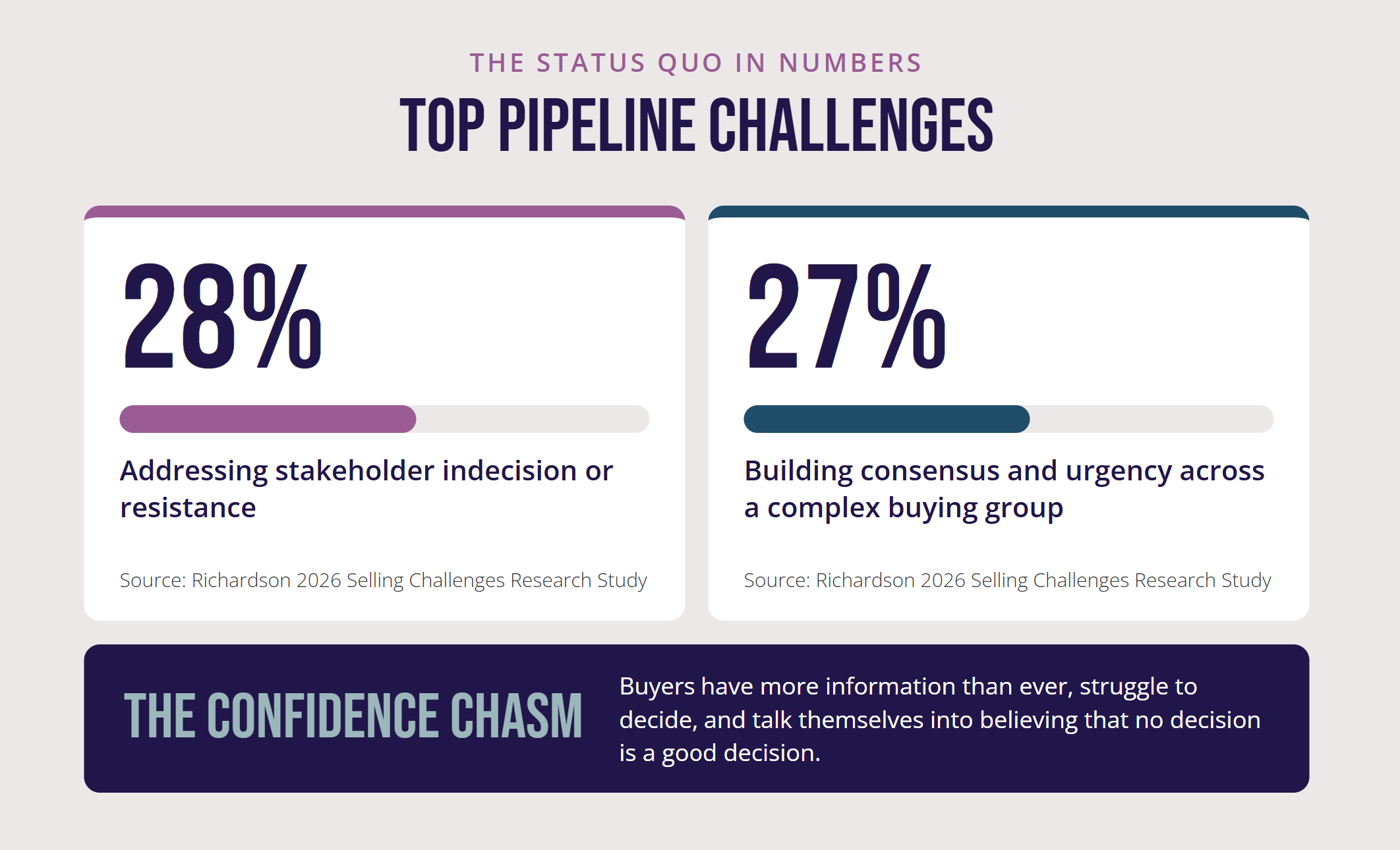
The status quo remains one of the biggest challenges in selling. In Richardson's 2026 Selling Challenges Research Study, addressing stakeholder indecision or resistance (28%) and building consensus and urgency across a complex buying group (27%) were the top two pipeline challenges. Richardson calls the result the confidence chasm: buyers have more information than ever, struggle to decide, and talk themselves into believing that no decision is a good decision.
Implementing a new solution brings more short-term challenges than staying the course. But the preference for the status quo is more complex than avoiding short-term hurdles. Researchers at Cornell University and the University of Chicago call one explanation sudden-death aversion. Analysing NFL and NBA decisions, then confirming the pattern in lab experiments, they found that people often choose a slower option that minimises the chance of immediate defeat, even when a faster one offers better odds of ultimate success.
The researchers attribute this to two forces: myopic loss aversion, a focus on the immediate risk that crowds out the long-term picture, and a sense of "tempting fate" when taking a risk that needn't be taken. In a sale, implementation and adoption are the near-term upheaval. They can root customers to the status quo, which avoids those responsibilities but may leave them in a less-than-optimal position.
Customers stand still because they see the outcomes of the status quo as certain. They avoid the proposed solution, despite its advantages, because they see its outcomes as uncertain.
What can sellers do?
- Show that the status quo is not certain. Psychologists Amos Tversky and Daniel Kahneman described the certainty effect: people avoid risk when one option is certain and the other is merely probable, even if it is more rewarding. What works today will not necessarily work tomorrow, so the status quo is less certain than it feels. Richardson recommends quantifying the cost of inaction — what a week or a month of delay costs — so buyers see not deciding as a choice.
- Appeal to logic and emotion. Everyone is susceptible to cognitive biases, so appealing only to the logical side is a mistake. Bain's 2018 B2B research found that business buyers weigh subjective value — ease of doing business, the individual, and inspiration — alongside functional value. Focusing only on logic often leads to decisions that hinge on price, which is risky when solutions are increasingly commoditised.
- Start small. Ease the burden of a large decision by asking for a small one first. The petition study above is the classic example of the "foot-in-the-door" technique: a small yes makes a larger yes more likely.
How does the default option influence a buyer's decision?
Researchers at Princeton and Columbia reviewed 58 studies of defaults, which are preselected options. They found that defaults exert a considerable influence on decisions, but that their effectiveness varies substantially, so both when and how they are deployed matter. Defaults influence how people plan for retirement and whether they donate their organs. In one study, employees were 50% more likely to join a retirement plan when enrolment was automatic.
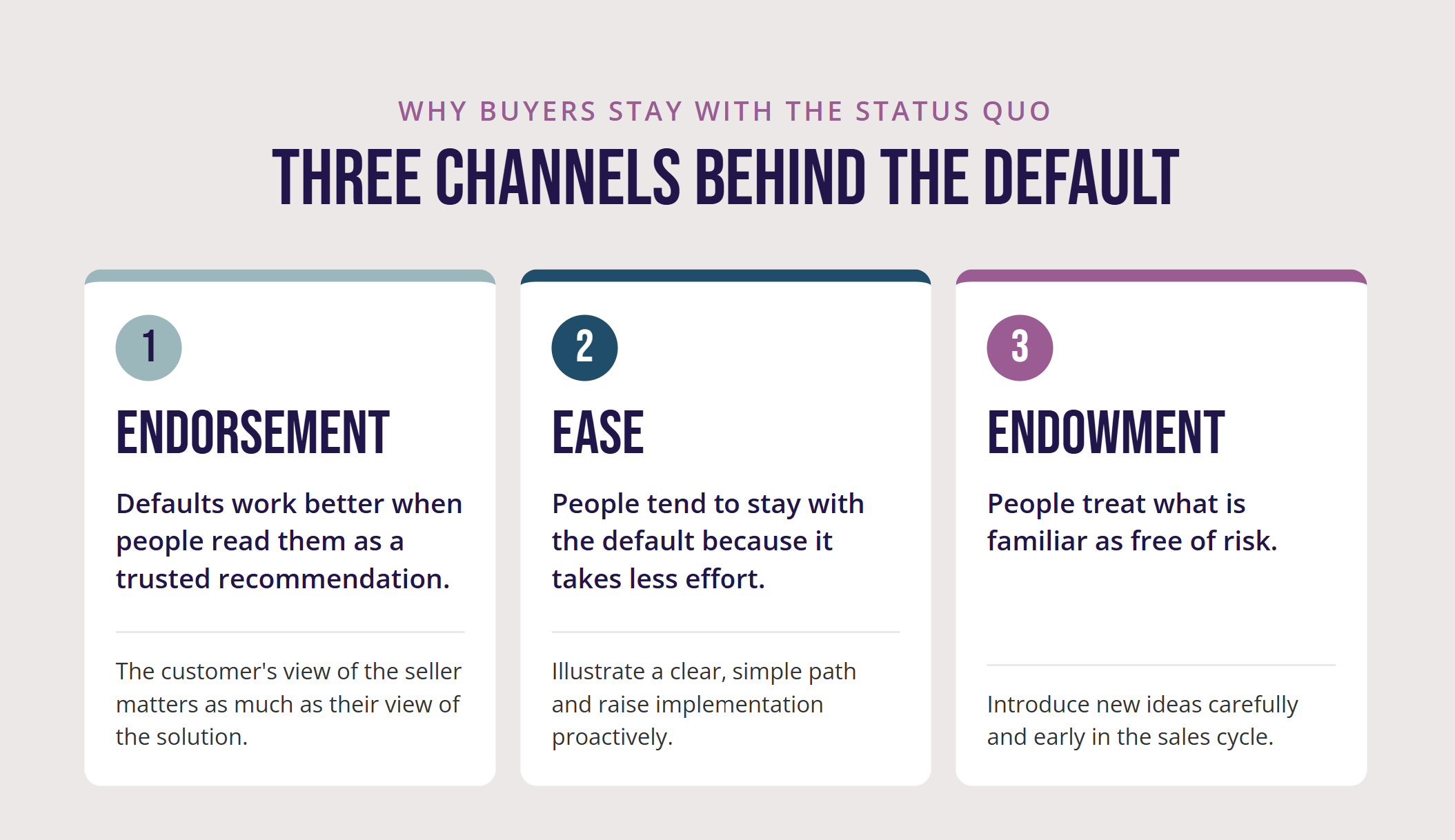
Those studies involved opt-in and opt-out choices, not B2B buying. In Richardson's view, the status quo often acts as the default in a sale. The researchers identify three channels through which a default works.
Endorsement
Defaults work better when people read them as a trusted recommendation. In the research, defaults were less effective when people didn't trust whoever set them. For sellers, that makes the customer's perception of the seller as important as their perception of the solution. The solution and the seller are one and the same, and customers need to know the seller's intentions match their own.
Ease
People tend to stay with the default because it takes less effort. This channel is the least settled: in the meta-analysis it did not significantly explain the variation, though the authors caution that it is hard to measure. Customers also judge solutions on how easy they are to implement. Few will voice implementation concerns, but those concerns sit in the back of their minds. Illustrate a clear, simple path, and fold the topic into the conversation proactively.
Endowment
The preference for the status quo also comes from familiarity. Defaults work better when people feel they reflect the status quo, and people tend to treat what is familiar as free of risk. Introduce new ideas carefully and early in the sales cycle, and gauge each stakeholder's reaction. That reduces the shock of a solution that is distant from the status quo, and it leaves time to build gradual buy-in and to understand the disparate goals among the decision makers.
How do expectations shape the way buyers feel about a decision?
At the 1992 Summer Olympics, bronze medallists appeared happier than silver medallists. Researchers attributed this to counterfactual thinking: silver medallists compare themselves with winning gold, while bronze medallists compare themselves with finishing without a medal. A later study of the 2000 Games added that expectations matter. Bronze medallists who weren't expecting a medal looked happier than silver medallists who had expected gold.
The same researchers tested this in the lab. Students took a verbal-ability test after a practice test. Some received feedback that created expectations, and others did not. Those with expectations reacted to their results according to what they had expected, not just what they got. As actual outcomes become more distant from expectations, emotions grow stronger.
A related idea comes from prospect theory, which Kahneman and Tversky introduced in 1979. People tend to feel the pain of losing money more than the pleasure of gaining the same amount — that is, "losses loom larger than gains." Later studies show the pattern is not universal, so this is a tendency, not a rule.
For sellers, expectations begin to shape outcomes before they unfold. Customers with realistic expectations are more likely to be pleased with the results, and more likely to return. Much of today's longer buying journey is customers forming their anticipated outcomes, so sellers who involve themselves early are better positioned to guide that process.
What can sellers do?
- Normalise risk. Much of the emotional side of buying is rooted in the risks inherent to a purchase. Discuss benefits and challenges openly, and point out that even choosing not to buy presents a risk, especially when the solution offers opportunities to advance the business. Sellers who can shift between logical and emotional reasoning as the buyer does will be better prepared.
- Assert a point of view, then ask reflection questions. Customers need a trusted advisor, and a trusted advisor offers expertise and input. Because asserting a point of view can feel threatening, first clarify your intent and show that the customer's interests are at the centre. Use concise language free of jargon, then ask questions such as "What are your thoughts on this solution?" or "Does this approach address the breadth of business needs you are facing?"
- Use a narrative. A story gives you a template for describing how the solution generated results for a similar customer, which helps buyers make the leap from theoretical to practical. Move from a challenge or need, to a solution, to an outcome.
Why do buying groups doubt a seller's recommendation?
Customers increasingly decide in teams, often with a shared history and sometimes a shared perspective. Researchers at the University of Queensland compared how groups responded to the same criticisms and recommendations for change from newcomers and long-term members. In every instance, newcomers drew less agreement and more negativity, and long-term members were more influential. Newcomers who seemed to relinquish ties to a former group were more influential in their new one.
The study didn't involve sellers, but the parallel is hard to miss. A seller is an outsider, and a recommendation implies some criticism of how the group works today. The 2026 Edelman Trust Barometer adds context: people are increasingly reluctant to trust anyone different from them. The more buyers see a seller as an outsider, the more they question that seller.
What can sellers do?
- Become customer-centric. Work from facts, not assumptions. Ask questions that reveal the nuances of the business challenge, how the decision-making process works, and what the customer considers an ideal outcome. Without that information, sellers anchor on one piece of information.
- Foster openness. Give to get. Offer insights that are relevant to the customer, drawn from in-depth research on their industry before the conversation. Every insight should help the customer make money, save money, or manage risk. To find the right ones, ask: What is likely unknown, misunderstood, or misperceived? What are the client's current beliefs? What assumptions are those beliefs based on?
- Adopt a mindset of authenticity. Every insight must answer the question "So what?" by connecting to the stakeholder's challenge. Authenticity is not a strategy. It comes from a sincere commitment to the customer's challenges and a genuine curiosity about how their business works. It matters because many deals never close: in The JOLT Effect, Matt Dixon and Ted McKenna found that 40% to 60% of lost deals ended in no decision.
How does context change what buyers choose?
Duke University professor Dan Ariely has shown that people often don't know their preferences well, so the context in which options are presented shapes their choices. He illustrates it with a trip to Rome or Paris. The two are hard to compare. Now add a third option: Rome without coffee, which you'd have to pay for yourself. Nobody wants it, yet it makes Rome with coffee look better, not just than Rome without coffee but than Paris. Rome with coffee becomes the top choice. Researchers call this the decoy effect.
The lesson for sellers: when buying decisions are complex and uncertain, customers lean on the context in front of them. It is the seller's job to create a context that makes the decision to buy an easy one. The solution must be at eye level.
Cognitive load theory suggests three demands that shape how easily people absorb new information. Each gives sellers a lever.
- Intrinsic load: the pre-knowledge needed to understand something new. Keep it low by tying value to the customer's specific challenge or opportunity. Every capability must connect to the customer's world — to driving revenue, reducing costs, or managing risk. A long list of capabilities is of little value unless each one is relevant.
- Extraneous load: material that has nothing to do with the concept at hand. Keep it low with ordinary language. In one experiment on online health information, technical language lowered how people rated authors' integrity and the credibility of their information. Clear, direct, specific language shows the customer that the seller is attentive to details.
- Germane load: the interpretation needed to grasp a concept. Keep it low by connecting the solution to the familiar — the "I get it, this is like that" moment. That takes constant collaboration to track the customer's changing needs. It pays off: Gallup's 2014 analysis found that fully engaged customers represented an average 23% premium in share of wallet, profitability, revenue, and relationship growth over the average customer, while actively disengaged customers represented a 13% discount.
Decisions don't occur in a lab. They occur in real life, where they are inconsistent, illogical, and incomplete. Sellers who remember that are better positioned to navigate the customer's decision-making process.