Why Is It So Hard for Pharma Reps to Get Time with Physicians, and What Works?
Sales performance improvement

Written by: Ben Taylor, MBA, Content Marketing Manager, Richardson
Published: November 13, 2026
The rising costs and system-wide constraints in healthcare force this industry toward transformation.
But while healthcare innovations accelerate to meet this demand, the leaders evaluating them struggle. The burdens of the old system, from staffing shortages and burnout to lengthy intakes and wait times, remain. This lag means healthcare decision-makers face more choices than ever when they are least prepared to choose.
For sellers, the scarcity constraining sales is attention.
Key Takeaways
- Attention, not access, is now the scarcest resource in pharma selling.
- Burnout, growing administrative loads, and a shrinking circle of trusted companies leave physicians little time for sellers.
- Reps earn that time by making the first few minutes relevant to the physician's clinical and operational reality, not by leading with product features.
Why do breakthrough therapies still struggle to reach physicians?
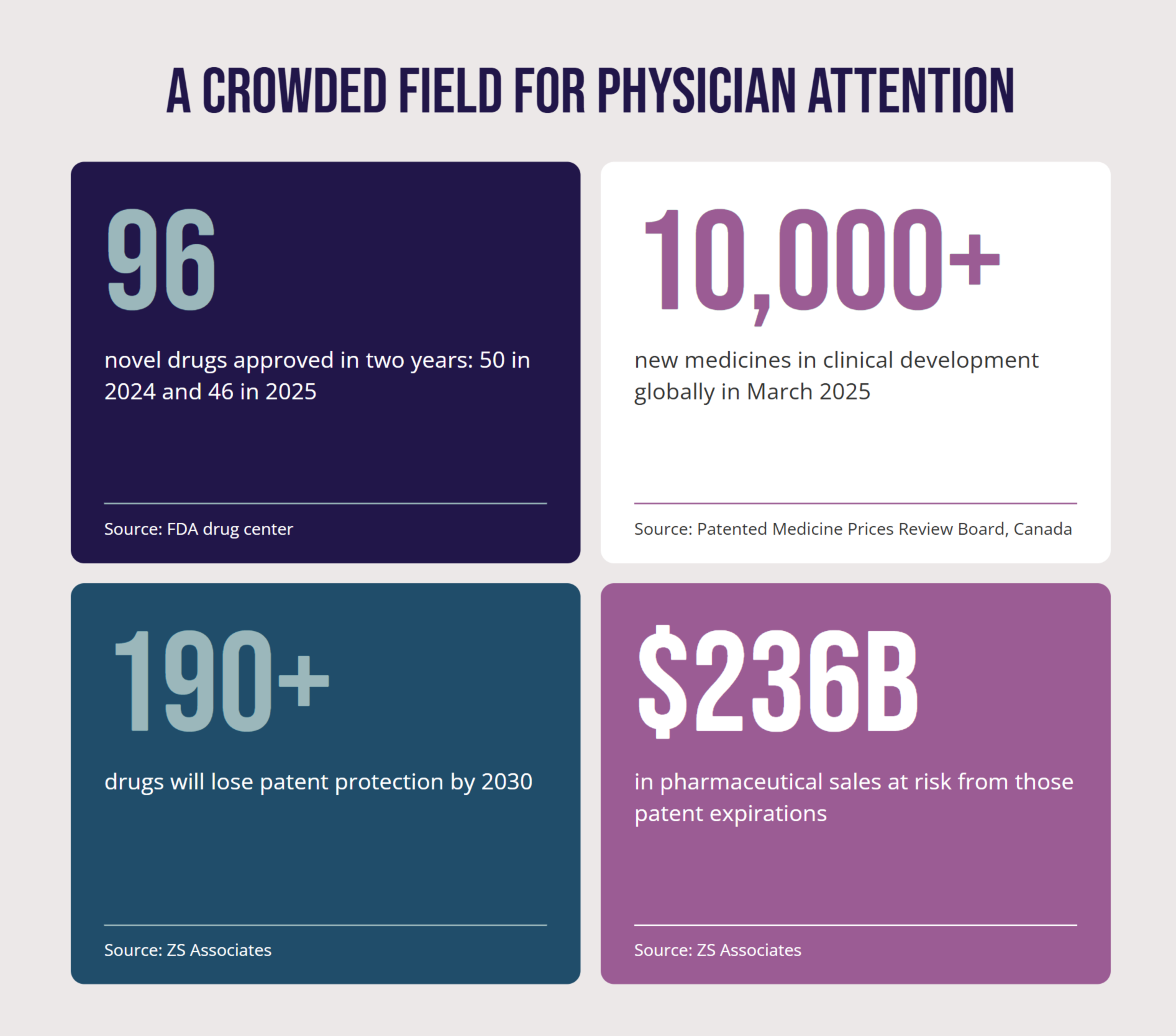
There's no denying the breakneck pace of innovation in pharmaceuticals. The FDA's drug centre approved 50 novel drugs in 2024 and 46 in 2025 — 96 in two years — flooding an already crowded therapeutic landscape. Physicians should be clamouring to prescribe these breakthrough therapies, and pharma reps should have no trouble selling them. Right?
But the pace of discovery hides a break in the innovation chain: the healthcare professionals who could benefit most from new discoveries don't have enough time to evaluate, let alone prescribe, them. Where reps could once rely on meeting physicians in person, building relationships over time, and gradually introducing new therapies and evidence, the new reality looks nothing like it.
Clinicians manage growing patient volumes. Administrative responsibilities continue to expand. Meanwhile, the body of medical knowledge keeps growing.
Sellers can no longer assume that innovation alone guarantees access to healthcare professionals. Gaining access is harder than ever, and when physicians grant it, the stakes are high. Lifesaving innovations are languishing on the shelf, and commercial teams face a new reality: attention — not access — is now the scarcest resource.
What structural pressures are shrinking physician attention?
It isn't in your head: setting a meeting in healthcare has never been this hard. Several converging forces now create an attention deficit in pharmaceutical selling.
Physician burnout remains widespread
Nearly half of US physicians (45%) reported at least one symptom of burnout in 2023, and physicians remain at higher risk than other US workers, according to a study published in Mayo Clinic Proceedings. The best physicians focus their narrow resources on improving patient care, limiting the time available for vendor engagement.
Physicians concentrate their attention around fewer companies
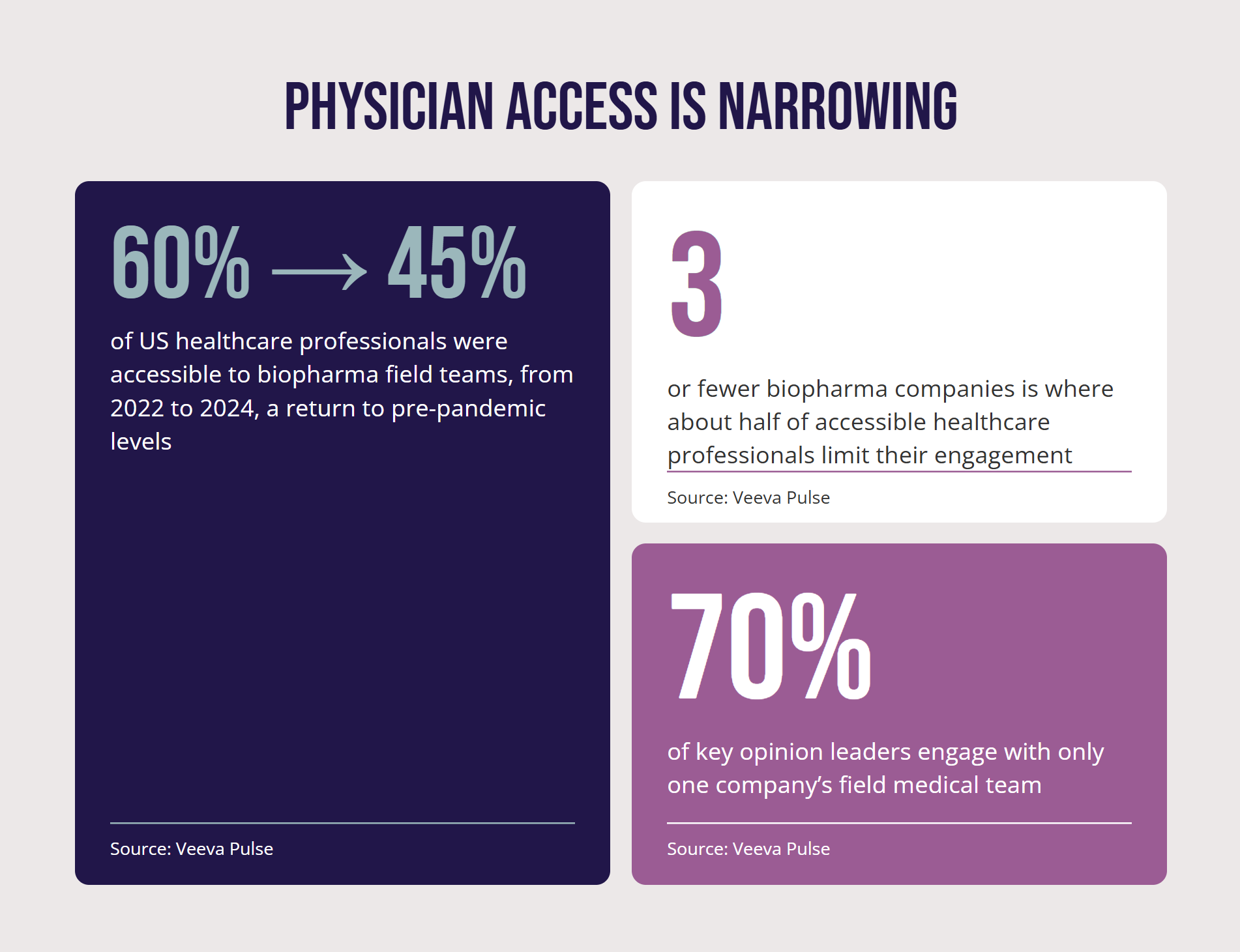
Veeva Pulse data show about half of accessible healthcare professionals limit engagement to three or fewer biopharma companies, and 70% of key opinion leaders engage with only one company's field medical team.
Physician access has fallen back
In 2024, 45% of US healthcare professionals were accessible to biopharma field teams, down from 60% in 2022 — a return to pre-pandemic levels, according to Veeva Pulse.
Pharma innovation continues to accelerate
The number of therapies under development continues to rise. Canada's Patented Medicine Prices Review Board counted more than 10,000 new medicines in clinical development globally in March 2025, intensifying competition for physician attention.
The patent cliff approaches
ZS Associates estimates that more than 190 drugs will lose patent protection by 2030, putting about $236 billion in pharmaceutical sales at risk.
Together these shifts create a new commercial equation: commercial teams must deliver greater value across every interaction, in dramatically less time.
Why isn't solving for access enough?
For decades, commercial teams focused on selling into healthcare by intensifying their focus on access. First, they built strategies on individual relationships through drop-ins and in-person meetings. When that strategy wilted during the pandemic, they turned to making digital inroads: outreach, omnichannel engagement, and coordinated sales and marketing activity. The post-pandemic playbook focused on digitising the same kind of relationship selling that's driven the successes of the past.
"If we could solve the problem of access," the thinking went, "our product's performance will win the day."
But information sources now surround healthcare decision-makers, meaning reps must compete against:
- Clinical research platforms
- AI-powered decision tools
- Medical societies
- Internal health system analytics
Physicians can now access clinical insights faster than a sales rep could deliver them. When your reps compete against algorithms, research platforms, and clinical data systems, they must deliver something those platforms can't: relevance. And they must do it within an incredibly tight window — or risk losing the opportunity forever.
Why does every physician conversation carry high stakes?
Selling into healthcare once meant building relationships through a series of low-pressure, low-stakes interactions. The realities of today's system make that approach impossible. The economics of customer interaction changed, and no low-stakes interactions remain.
If physicians engage with only a handful of companies — and those interactions last only minutes — then every conversation becomes disproportionately important.
Yet many pharmaceutical sales organisations are still built for a world that assumed:
- Repeated access
- Longer conversations
- Gradual relationship building
Today's reality is different. When time-strapped physicians give sellers their most precious resource, they're looking for something in return: value. If a seller's conversation doesn't immediately deliver that value with relevant insights, they put future opportunities at risk.
Every interaction in an attention-constrained healthcare system either earns the buyer's trust or closes the door for good.
What works instead? Human-centred selling
Sellers who want to get their life-changing, lifesaving innovations into the hands of physicians need to do more than sell their novel therapies. They must earn a spot at the table through a focus on human-centred transformation.
Instead of approaching healthcare professionals primarily as prescribers, leading organisations engage them as professionals navigating enormous clinical and operational pressure. The human-centred transformation approach changes every aspect of the sales process. It affects how sellers prepare for conversations, the insights they deliver, and how they deliver them.
| Traditional sellers focus on | High-performing sellers focus on the human realities healthcare leaders face |
|---|---|
| Product features | Clinician workload and burnout |
| Clinical trial data | Patient outcome challenges |
| Promotional messaging | Operational constraints within healthcare systems and financial pressure shaping healthcare decisions |
Instead of competing for attention, sellers earn it by making the conversation immediately relevant to the physician's reality.
What capabilities help pharma sales teams earn physician attention?
For chief sales officers and chief revenue officers, the critical question now is: Can your sales teams create value in the first few minutes of every interaction? Richardson Sales Performance sees the most successful organisations prioritise three capabilities.
- Commercial Insight development. To win the right to sell, reps can't focus on features and benefits. They also can't assume that buyers want to act — or even understand why acting now is essential. The most successful sellers deliver a story that deconstructs a buyer's thinking, dismantles their underlying beliefs and assumptions, and then leads toward a new solution. This six-step choreography, called Commercial Insight, equips sellers to introduce insights that reshape how healthcare leaders evaluate solutions.
- Human-centred selling skills. Successful sellers use the respect earned by delivering a Commercial Insight to change the way buyers view them. They use questioning and positioning to dig into the real problems facing their buyers, taking a consultative approach and becoming trusted advisors who help buyers come to decisions. Most importantly in a healthcare setting, they don't see their buyers as prescribers alone; they engage them as professionals navigating intense operational pressure.
- Stakeholder navigation. In healthcare, sellers prepare to align complex buying groups around measurable clinical and operational outcomes. Sellers who address these fundamental elements of the buying experience turn attention and adoption into impact that drives long-term relationships.
Darnetta Daire, Sales Enablement Manager at Hollister Incorporated, describes what that looks like in coaching: "We're able to coach specifically to, hey, how are reps doing with understanding needs? How are reps doing with connection? How are reps doing with recommending our products?"
What results can pharma sales teams expect?
A global pharmaceutical company operating in a complex healthcare ecosystem needed to move beyond product-focused discussions. Its sales teams must engage physicians, hospitals, and healthcare systems with highly regulated products. The company wanted them to develop stronger consultative conversations that better align with the clinical and business priorities of healthcare stakeholders.
Richardson Sales Performance partnered with this company to strengthen consultative sales capabilities through programmes such as Consultative Selling™ and related enablement initiatives. The focus was on improving sellers' ability to:
- Diagnose customer needs more effectively
- Connect clinical value to business outcomes
- Conduct structured, outcome-driven customer conversations
Typical outcomes from Richardson engagements include measurable commercial improvements such as:
- 20% improvement in close rates
- 25% increase in sales productivity
- 24% improvement in sales skill proficiency
- 35% increase in knowledge proficiency
- 5–12% revenue growth
A pharmaceutical company facing a patent cliff saw new and existing prescriptions increase 46% one month after training, and the increase held for nine months.