Why Is Roleplay Important in Sales Training?
Sales performance improvement

Written by: Ben Taylor, MBA, Content Marketing Manager, Richardson
Published: November 13, 2026
Every seller practices. The only question is whether they do it before the customer conversation or during it.
Buyers have changed how they approach a purchase, and sales leaders have never had fewer chances to get customer conversations right. Sellers increasingly face AI-informed buyers with high expectations and strong preferences.
When they do get time with a customer, the margin for error is gone. They must nail the fundamentals — establishing credibility, creating value, moving forward — while navigating buyers who arrive with preferences already set.
Revenue leaders already invest heavily in building knowledge: hiring, training, onboarding, messaging, product positioning, and coaching when performance falls short. Yet knowledge isn’t the limit. Sellers get too few chances to turn what they know into execution. And when sellers don’t have room to practice against a defined standard, they take their practice into live customer calls.
Key Takeaways
- Roleplay gives sellers a place to practice before the customer conversation instead of during it.
- It matters more now because buyers arrive with preferences already set, which leaves sellers fewer live chances to get it right.
- Roleplay works best when you score it against a clear standard and connect it to the training and coaching sellers already use.
How has buying changed, and why does that raise the stakes for practice?
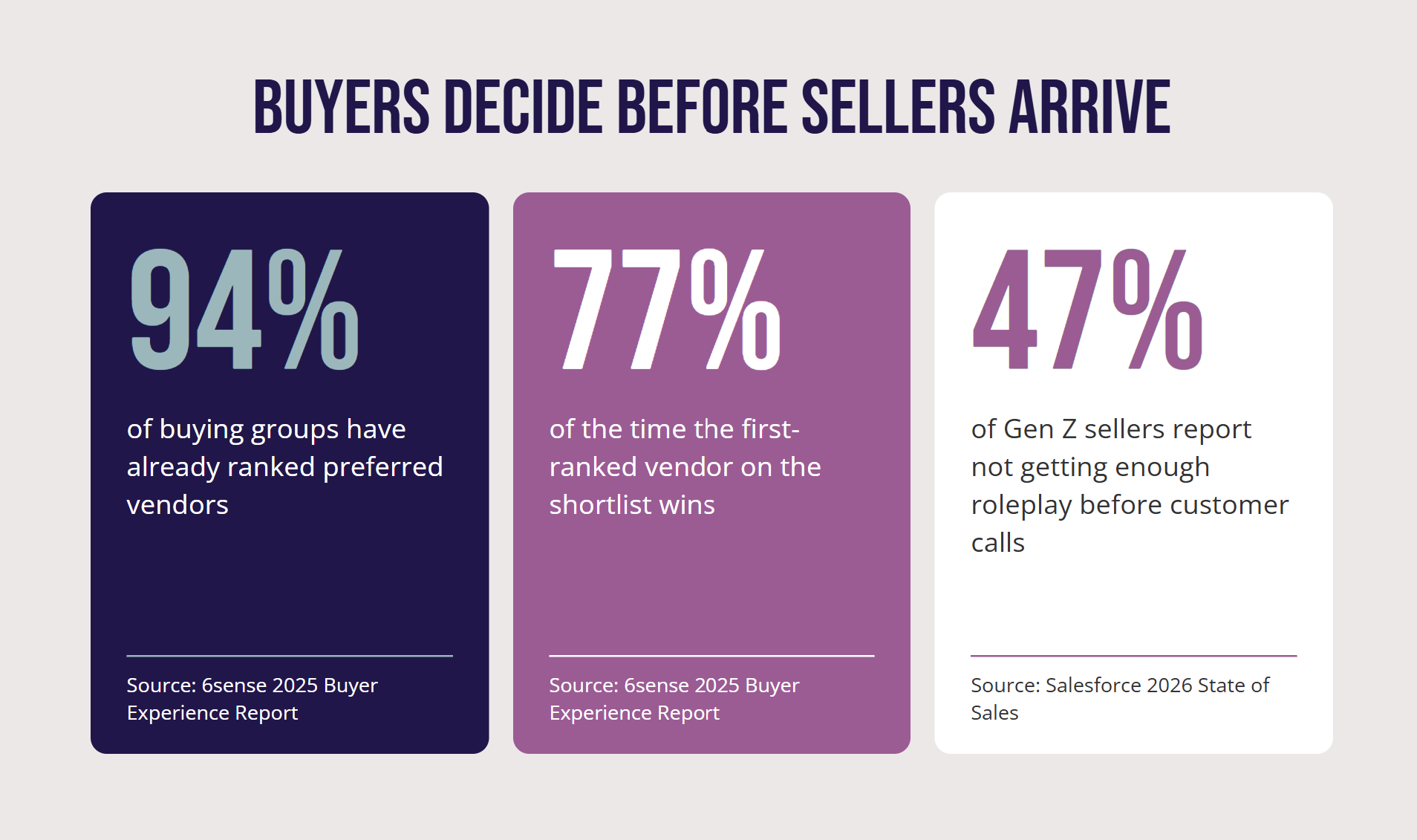
6sense’s 2025 Buyer Experience Report found that buyers now arrive as part of groups that, 94% of the time, have already ranked preferred vendors, and the vendor ranked first on that shortlist ultimately wins 77% of the time. Sellers now enter most customer conversations against entrenched preferences and an already-advantaged competitor. The same research found that 94% of B2B buyers report using LLMs during the buying journey.
That raises a new risk: sellers don’t have enough opportunities to practice the skills they need most. Salesforce’s 2026 State of Sales research found that 47% of Gen Z sellers report not getting enough roleplay opportunities before customer calls, while 46% say they rarely receive feedback on their sales conversations. The early-career sellers who most need practice are going into customer conversations underprepared and outmatched by experienced buyers.
Early-career sellers aren’t the only ones who benefit from practice. When buying groups have largely established their preferences before seller engagement, experienced sellers need room to practice new sales motions too. The questions that matter show up later: whether sellers can create enough value to alter an established decision, and whether leaders notice a limited number of winnable opportunities passing before they become visible performance gaps.
What does it cost when live customer calls are the only practice field?
When sellers can only build proficiency in live conversations, the cost eventually surfaces in win rate. But there’s a hidden cost that managers rarely catch until it’s too late. To see it, look at the experience gap from the seller’s side.
Imagine you’re a seller walking into a high-stakes executive conversation knowing you have to nail it. The buyer has done their research, the buying group has strong preferences (mostly for a competitor), and your manager’s expectations are high. Yet you’re still working out which messages resonate with this audience, how to respond when challenged on price, and how to manage a sudden shift in the conversation.
The consequences don’t stop with the call. The manager can’t diagnose what went wrong until the moment has passed. Revenue leaders only see another deal moving backward in the forecast, and have no information about whether it was the strategy, the execution, or a lack of preparation.
For struggling sellers, that experience compounds into lost confidence, performance dips, and growing pressure to hit an increasingly unachievable goal. For top performers, the risk is different — but still costly. Their fallback approach stops working when buyers, markets, and expectations change, and all three are changing. Without the chance to practice, they won’t notice the shift until an important customer conversation exposes it. At that point, they face a choice: keep defaulting to what worked in the past, or, just like early-career sellers, practice unfamiliar approaches on live conversations that could anchor the year’s revenue plan.
Why do sellers need a space to fail?
When the only place to make a mistake is in front of the customer, sellers stop making them — because they stop trying. Learning any new skill means making errors, and sellers can’t afford a high error rate in a deal that makes or breaks their quota.
In a 2008 meta-analysis of 24 studies and more than 2,000 participants, published in the Journal of Applied Psychology, learners who were told errors were part of the process and taught to work through them ended up outperforming those trained on careful step-by-step instruction designed to avoid mistakes. Most of the studies taught software skills. When the test asked learners to apply the skill to something new, the typical error-tolerant learner outperformed roughly seven in ten of their error-avoidant counterparts. On tasks similar to what they’d already practiced, the gap narrowed to a small one.
The two groups didn’t differ in knowledge or effort. They differed in what they were told an error meant. When told errors were evidence of a mistake to be avoided, they worked to avoid them. When told errors were crucial to building skills, they pushed their limits in pursuit of improvement. The research suggests that permission to fail is not a nice-to-have for skills that have to hold up in new situations.
The analysis also showed a finding that matters for revenue leaders: during the training itself, the error-tolerant group showed no significant advantage. The difference only appeared afterward, in whether the skill held up when it counted. That’s why a practice space that challenges sellers, develops them, and gives them the feedback they need to improve belongs at the top of every commercial team’s to-do list.
“When you put those behaviors into practice — questioning and listening, having facilitated sessions with coaches that actually get in there and can coach them along the way — our teams are better able to actually apply some of those behaviors in the moment with their customers.”
— Amber Boll, Director, Sales Global Process Owner, Rich Products Corporation
Does the quality of practice matter?
Yes. Rapid AI advances make it possible to spin up a personalized practice environment in minutes. Speed helps, but it isn’t enough. Without a human-built standard scaffolding the practice, every attempt entrenches the wrong behavior.
In a Wharton field experiment with nearly 1,000 high school math students, one group practiced with a generic AI assistant, one with a version that had safeguards to guide students toward answers instead of handing them over, and one with no AI at all. Researchers then took the AI away and tested all three. The study tested math, not selling, but it shows why the design of practice matters.
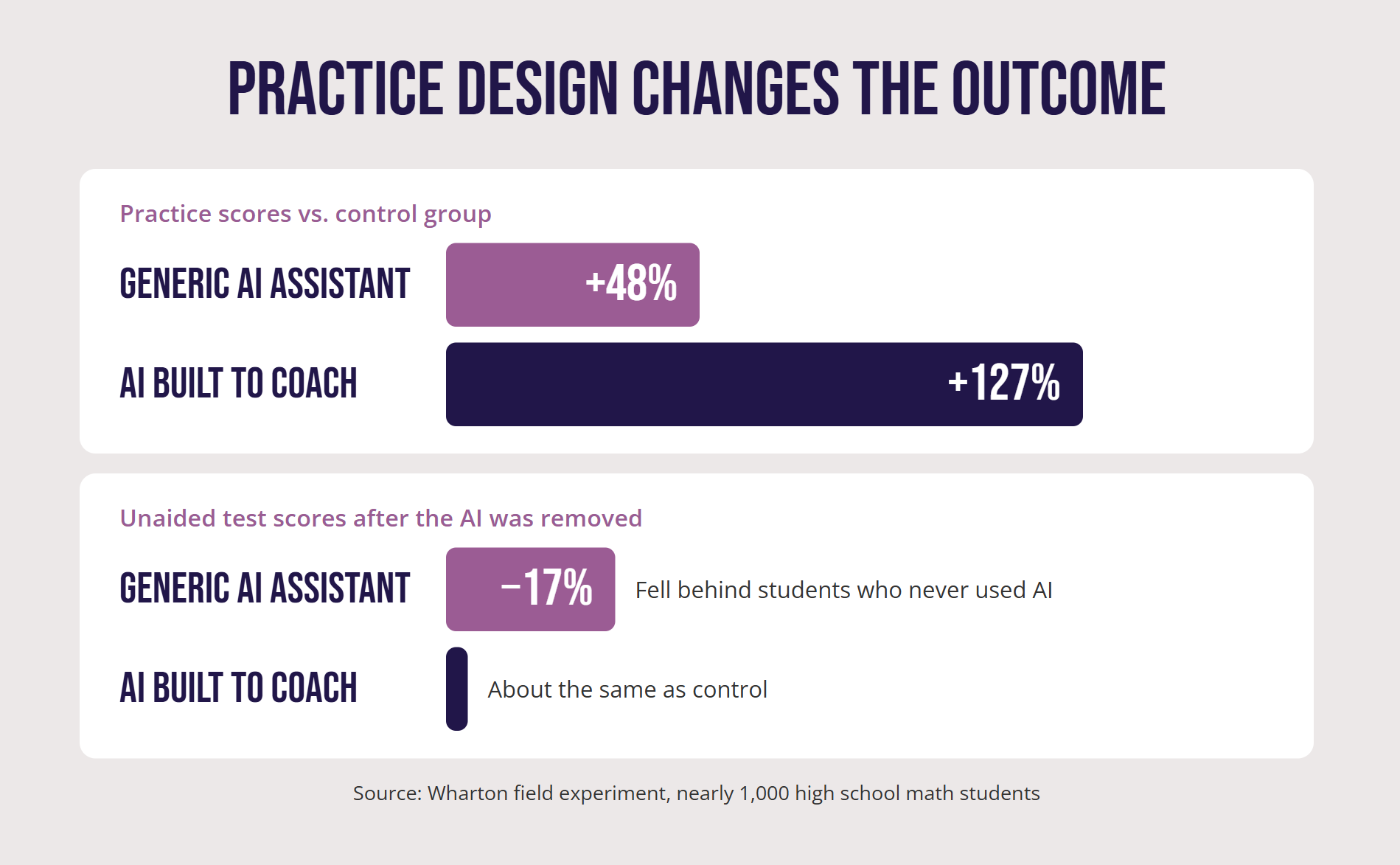
| Group | Practice scores vs. control | Unaided test scores vs. control |
|---|---|---|
| Generic AI assistant | 48% higher | 17% lower |
| AI built to coach | 127% higher | About the same |
The coached group held steady when the AI was removed, while the generic group fell behind students who had never used AI.
The same pattern holds in a sales population. Among nearly 6,000 frontline reps surveyed by CEB (now Gartner), bad coaching hurt performance nearly twice as much as good coaching helped. Bad coaching was worse than no coaching at all. A practice bot with no defined standard is an unskilled coach, and it will never tire of making things worse.
Leaders shouldn’t ask how quickly they can build the practice field. They should ask whether it enforces the right behaviors and improves performance.
What do the best roleplay programs get right?
To get ahead of the compounding effect of too little good practice, sales leaders need a practice environment that is customized, tied to methodology, and rigorous in its feedback — and quick to build and deploy.
Realistic and personalized. The best practice environments personalize customer profiles, product and solution sets, value propositions, specific challenges, and common objections. Sellers should also have the flexibility to try out new sales motions in full conversations or focus on a single weak behavior. A “good” roleplay looks different for different sellers. For some, it means a simulation that accurately scores how well a seller can engage a CFO, who in many industries is the main decision-maker. For others, such as those selling a SaaS solution, it hinges on the ability to quickly and accurately address concerns about implementation.
Built around a standard. It’s not enough to personalize scenarios, because while AI simulates a realistic conversation quickly and convincingly, it doesn’t know what good selling sounds like. The strongest practice scenarios are purpose-built for sellers and engineered around observable behaviors. That means scorecards that grade every conversation against a clear, consistent standard. That backbone guides how the simulation challenges the seller, which behaviors it evaluates, what feedback it provides to sellers and their managers, and — most importantly — where sellers should focus in their next roleplay.
“We’re able to coach specifically to, hey, how are reps doing with understanding needs? How are reps doing with connection? How are reps doing with recommending our products?”
— Darnetta Daire, Sales Enablement Manager, Hollister Incorporated
Richardson’s AI Roleplay, built on Hyperbound inside Accelerate Prism, follows this approach. Richardson configures each experience around the client’s selling environment, and feedback is grounded in Consultative Selling and Challenger behaviors. To see how AI tools fit into a methodology-led approach, read Richardson’s guide to AI in sales training.
Connected to a feedback loop. The best roleplay systems do all of this within a connected feedback loop that brings roleplay into the training and reinforcement environments sellers already know. In Accelerate Prism, roleplay sits in the Reinforce step of the learner journey, so practice results help guide what sellers strengthen next and where managers should coach. That’s the step that shows revenue leaders whether roleplay moves the number. It builds consistent execution before the conversations count and makes seller behavior a forecastable input, not a black box.