
Sales Process Optimization Linked to Verifiable Outcomes
At Richardson Sales Performance, we define the sales process as:
A consistent set of trackable steps that includes stages and gates, is used for forecasting, goes from beginning to end, and is typically tied to a CRM.
With more than two decades of sales process development experience, Richardson Sales Performance has developed a proven methodology for rapidly and efficiently designing and documenting optimized sales process definitions for clients. Each sales process consulting project is organized into distinct phases, with clear success criteria in each phase, as follows:
- Align: ensure that the goals and objectives of the sales improvement project are congruous with the company’s growth strategy, and that the project is staffed with the talent and resources required to succeed.
- Assess: identify the sales team’s current state, the ideal state, critical performance gaps, and then develop plans to realize desired outcomes
- Develop: transfer required knowledge of effective practices, methods and tools required to attain the desired sales performance improvement goals
- Perform: raise mastery of effective practices by monitoring observable behaviors in the sales team, and reinforcing adoption and application in real-world selling situations
- Analyze: measure and evaluate the success of the initiative, and align organizational systems and practices to ensure ongoing success
With this model, Richardson Sales Performance ensures clients achieve consistently high-quality results more rapidly.
Our Sales Process Consulting Approach
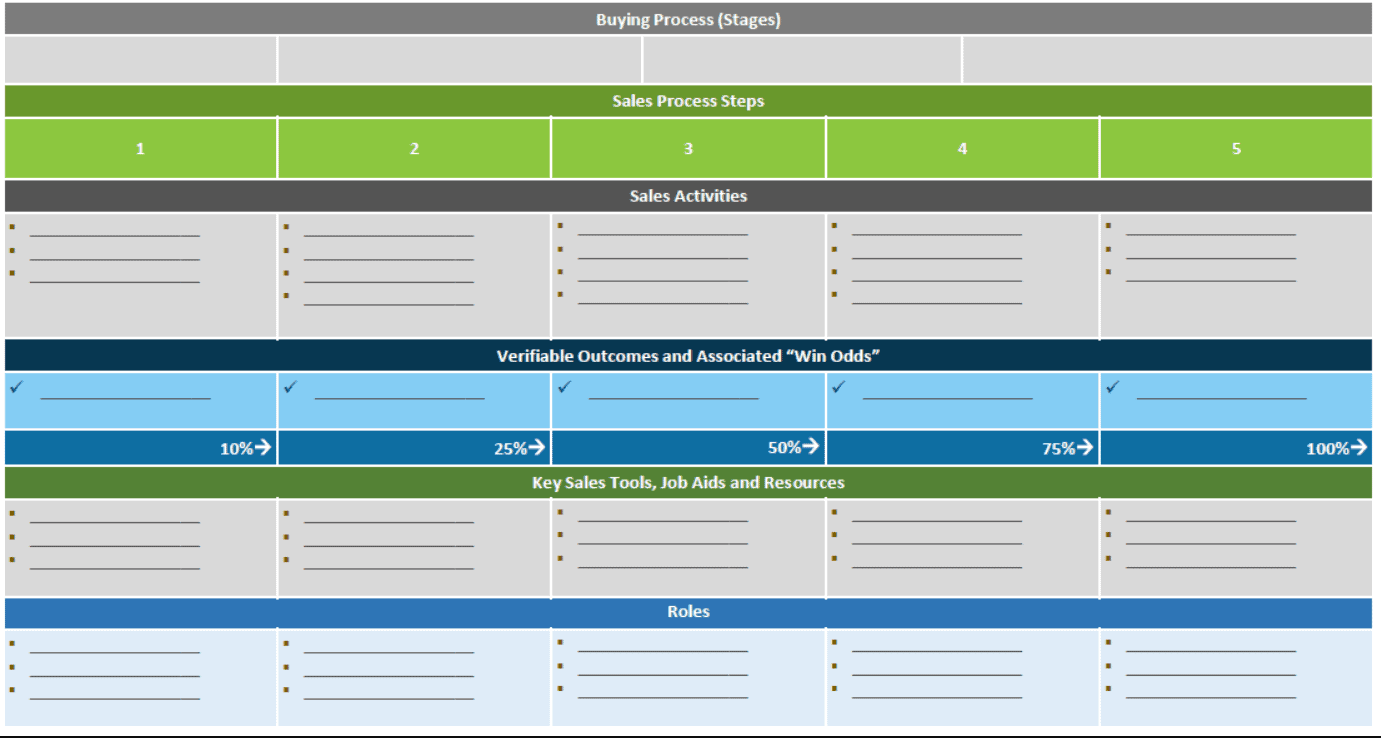
The principal deliverables of this methodology are sales process maps, showing the key selling steps aligned to buyers’ preferred purchase behaviors.
These maps include definitions of recommended sales activities, verifiable outcomes, relevant sales tools, and resources engaged in each step. The maps guide salespeople to more consistent sales results and enable sales managers to significantly improve the quality of forecasting and coaching.
Creating A Sales Process for Your Team
The steps to customizing a sales process for your team include:
- Structured interviews (approximately 1 hour each) with a representative group of sales leaders, managers, operations, and sellers (typically 5-6 interviews)
- A review of current policies and standards: sales process definitions, related artifacts, and systems (CRM or other sales-related support applications and tools)
- Collation of results and findings, including initial definitions of tailored selling processes
- 1-day facilitated workshop to review and revise sales process designs, tailored for latent and active opportunities (maximum 10 participants)
- Documentation of the agreed-upon sales process map(s)
Benefits of an Optimized Sales Process
Establishing a sales process that optimizes the quality of each customer’s experience differentiates a sales team's value through their interactions with buyers. Optimizing your sales process is proven to deliver the following additional business benefits:
- Reduces new sales hire ramp-up time by providing maps for success
- Reduces cost of sales by defining optimal engagement of selling resources
- Defines sales manager inspection criteria and cadence for improved coaching
- Provides standards for effective pipeline and opportunity quality reviews
- Sets standards for accurate forecasting
- Aligns sales process within CRM applications, increasing system adoption and compliance
- Improves customer experience (CX) with the sales team, resulting in higher win rates
- Enables marketing to align with and support sales efforts


Our Impact
900
Global Clients3.5M+
Individuals Trained12%
5-12% Increase in Revenue24%
Improvement in skill efficiency35%
Increase in knowledge proficiency